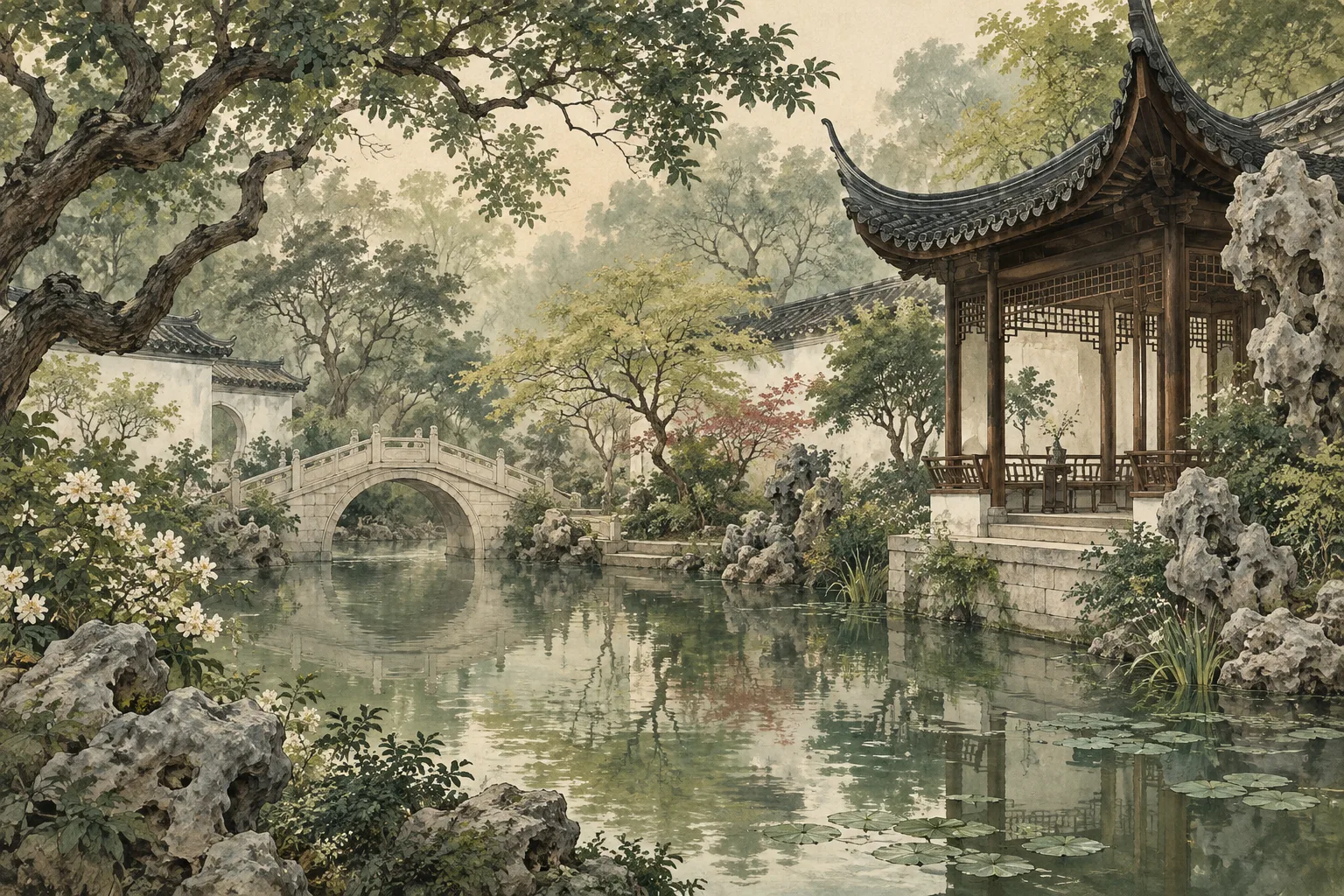
Why are pavilions useful places to start looking?
A pavilion can give a garden painting a human scale and an imagined place to pause. Its roof and posts are often easier to locate than the twisting edges of trees or rocks. Start there, then ask how paths, water and nearby buildings connect it to the surrounding scene. This is a viewing method, not a fixed symbolic meaning for every pavilion.
A garden that resembles nature
The Metropolitan Museum of Art’s Pavilion on a pond is a fan mounted as an album leaf, painted in ink and color on silk and dated to the sixteenth or seventeenth century. The museum identifies its elaborate rocks, stone bridge and buildings across the water as clues to a designed garden. Its current artist heading is “Unidentified artist”; an older attribution to Li Song should not be treated as settled authorship. The Met: Pavilion on a pond.
That distinction helps frame the scene. Instead of assuming that every rocky waterside view describes untouched countryside, look for signs of deliberate arrangement. A bridge provides access. A building frames a destination. Rocks can organize what is seen from a particular position.
Trace an imagined visit
Begin at the pavilion and try three questions:
- Where could someone stand or sit? Look for an open side, a platform or an edge facing the pond.
- How might someone arrive? Follow the visible bridge or path. If the route disappears, leave it uncertain rather than inventing a complete floor plan.
- What would hold their attention? Compare the nearby rocks with the view across the water. Notice how the composition moves between enclosure and openness.
These questions are an invitation to observe. They do not prove the exact use of a historical building or establish that a painted garden existed in precisely this form.
Does a pavilion always mean solitude?
No single reading should be assumed from the building alone. Check whether the scene includes people, and whether the title or inscription identifies an occasion. The Met’s Chinese Gardens exhibition explains that celebrated gardens, poetry and painting could inspire later garden design. A garden image can therefore involve remembered or literary places as well as visible architecture. The Met: Chinese Gardens.
For a second looking exercise, compare the pavilion’s firm outlines with the softer forms around it. Then explore mist in Chinese landscapes or how to view a handscroll. The journal offers more ways to move from a first impression to specific details.