How to Read Chinese Landscape Painting: A Guide to Shanshui
A practical introduction to Chinese landscape painting, from “mountains and water” to Wang Ximeng’s Northern Song masterpiece.
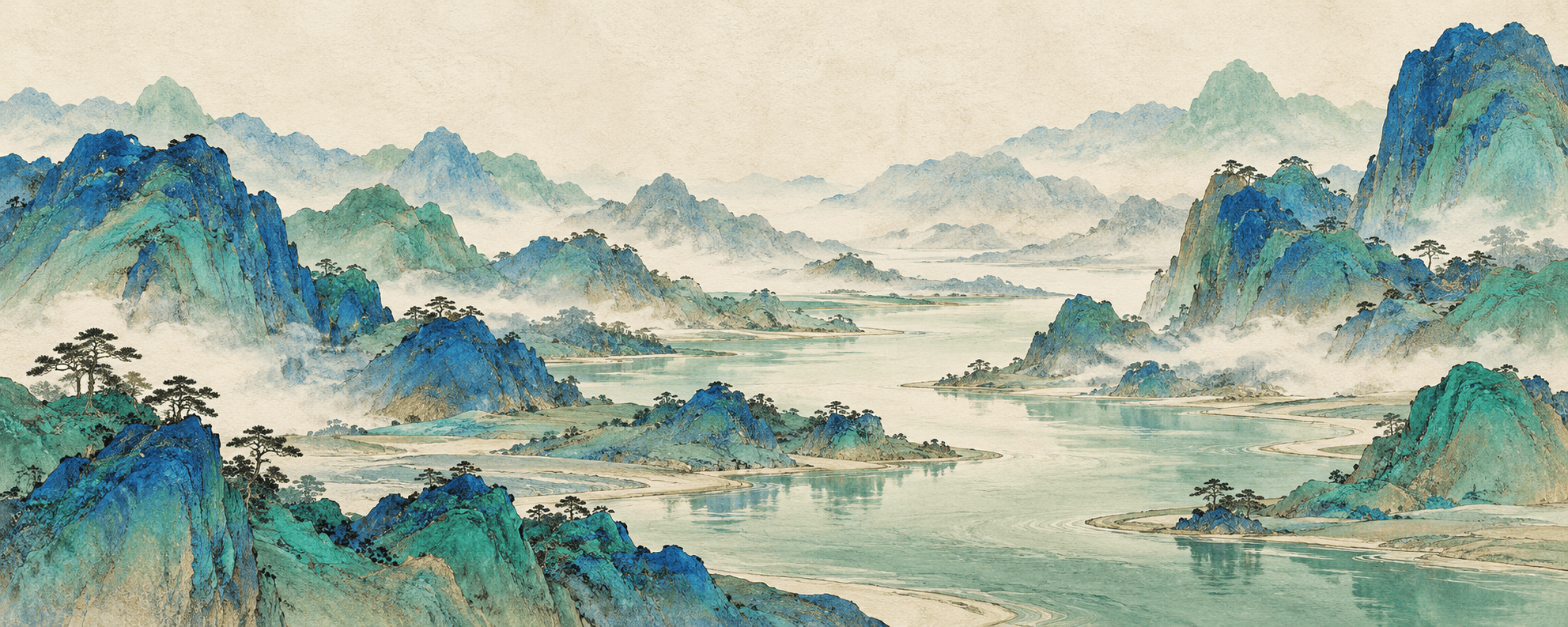
A Chinese landscape painting can look quiet at first. Then the eye begins to travel: up a mountain face, across a bridge, into a distant pavilion, and back toward a tiny figure near the water. That movement is one way into shanshui (山水), the Chinese term for landscape, literally “mountains and water.”
The word is useful because it describes more than a view. In Chinese painting, mountains and water form a relationship. Space can suggest distance, weather, human presence and the possibility of retreat. The Metropolitan Museum of Art describes landscape painting as a way of conveying an artist’s inner landscape, as well as social, philosophical or political ideas. A painting may invite imagination without offering one fixed message.
1. Start with the route, not the “meaning”
When you meet a landscape painting, resist the urge to decode it immediately. First ask: where does the image ask me to look?
Many Chinese landscapes are built for a moving gaze. A path, river, ridge or chain of buildings can lead the eye from one passage to another. In a handscroll, this movement is especially important because the work is encountered gradually rather than all at once. Look for changes in scale, pauses created by mist, and small signs of human activity.
This is a form of looking, not a promise that the painting will produce a particular feeling. Your response may be calm, curious, unsettled or simply attentive.
2. Notice how mountains and water share the picture
Mountains provide height, weight and structure. Water opens space and connects separate parts of the composition. The balance between them can make a landscape feel monumental, open, enclosed or changeable.
The Palace Museum identifies blue-green landscape, or qinglü shanshui, by its use of blue and green mineral or plant pigments. The style developed from earlier traditions and was refined during the Song dynasty. These colours are not just decoration: they help organize the painting’s different distances and surfaces. Read more in the Palace Museum’s exhibition overview of blue-green landscape painting.
3. Look closely at the small figures
Tiny travellers, boats, bridges and houses can change the scale of an entire painting. They remind us that the landscape is not an empty backdrop. People move through it, work beside it, cross it and pause within it.
In a large composition, a small figure can also make a mountain feel larger without requiring realistic measurement. The relationship is expressive: human life is present, but it shares the world with forces that exceed it.
4. Meet Wang Ximeng’s A Thousand Li of Rivers and Mountains
One of the most celebrated examples of blue-green shanshui is Wang Ximeng’s A Thousand Li of Rivers and Mountains (Qianli Jiangshan Tu), held by the Palace Museum. The museum describes it as the only surviving work by the Northern Song painter Wang Ximeng. It is a silk handscroll measuring approximately 51.5 cm high and 1,191.5 cm wide.
The scroll moves through linked mountain and water passages. The Palace Museum notes its use of multiple spatial approaches—“high distance,” “deep distance” and “level distance”—and the way bridges and streams connect sections of the composition. The result is not a single viewpoint. It is a journey assembled through changing views. See the Palace Museum collection record.
The colour is equally distinctive. Mineral blues and greens create a jewel-like surface, while touches of other colour and finely drawn details keep the long composition from becoming uniform. At close range, you can find boats, buildings, trees and figures. At a distance, those details gather into an expansive rhythm of peaks and waterways.
5. Bring the painting into your own space carefully
Living with an image of a historical painting is different from owning the original. Before choosing a digital edition or print, check the image’s actual proportions, file contents and permitted use. A long handscroll may need a wide wall or a carefully selected detail; stretching it to fit a standard frame can distort the composition.
The most useful question may be simple: what kind of looking does this work make possible in your room? A landscape can give you a route for the eye, a pause in a busy day, or a reminder that an image can unfold over time. The answer belongs to your experience, not to a guaranteed symbolic formula.
HUALI’s collection pairs historical context with a contemporary reading of each work. Continue with the A Thousand Li of Rivers and Mountains story page, or compare it with other works in the collection.
Palace Museum, “Wang Ximeng, A Thousand Li of Rivers and Mountains”; Palace Museum, “A Panorama of Rivers and Mountains”; The Metropolitan Museum of Art, “Landscape Painting in Chinese Art.” Links above point to the original museum sources.
Keep reading
- How Do Chinese Landscapes Show Distance Without One Vanishing Point?Learn to spot high, deep, and level distance in Chinese landscapes, and see why a painting may offer several ways to travel through space.
- Why Does Chinese Landscape Painting Leave So Much Blank Space?Blank paper in a Chinese landscape can suggest water, sky, mist, or distance. Here is a practical way to read the space around the ink.
- How Does Mist Create Depth in Chinese Landscape Painting?See how mist separates near and far mountains in Chinese ink painting and learn a simple way to follow its changing spaces.
New articles by email
Occasional notes on Chinese painting — how to look at it, and what to know before you buy. No more than a few emails a year. Unsubscribe any time.
We store your email address only to send these notes. We do not share it. See our privacy notice.