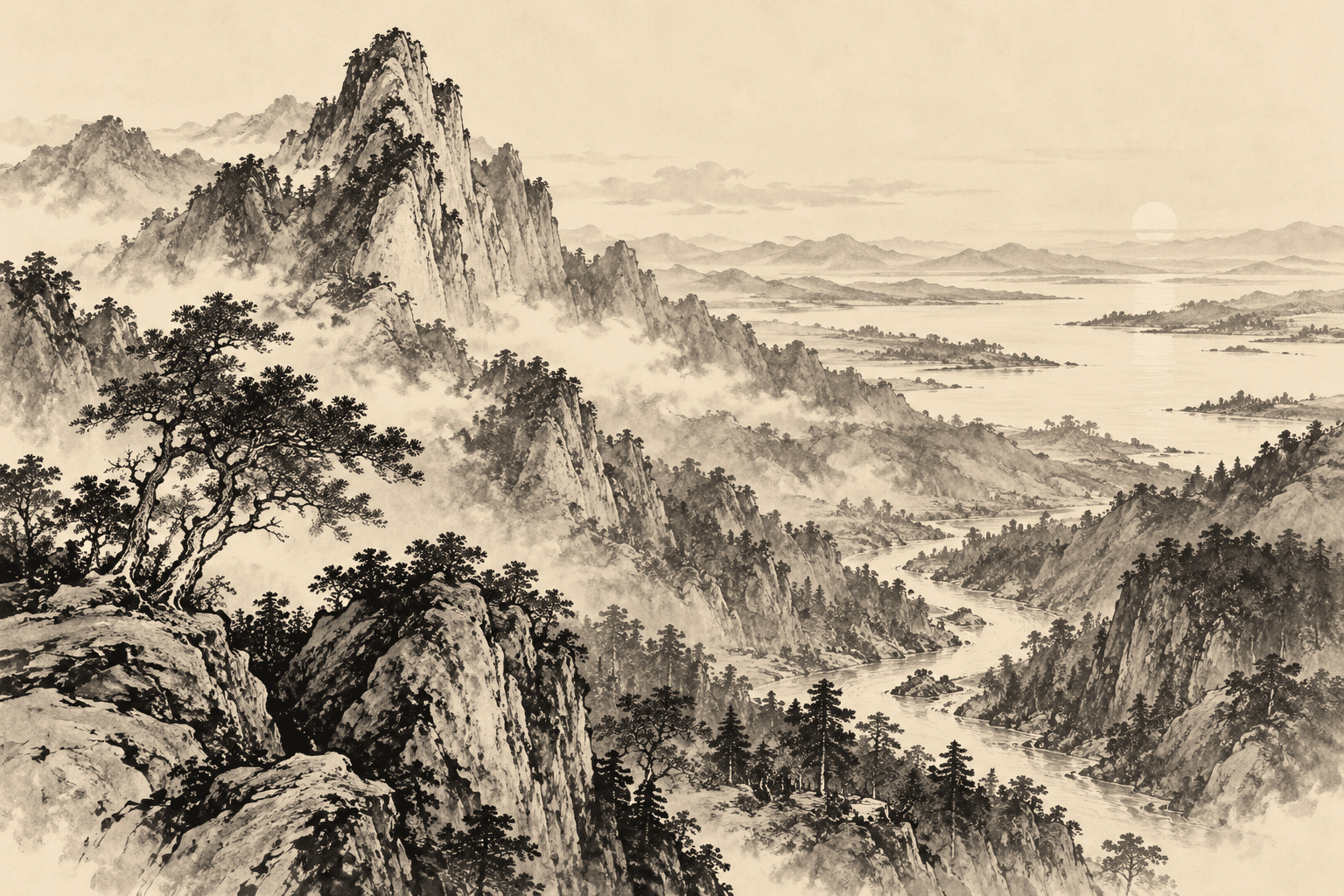
Many Chinese landscapes do not ask you to stand at a single fixed point. Your eye can rise from a near slope toward a summit, enter a valley between mountains, then travel across a broad lowland. These are useful ways to understand the traditional idea of high, deep, and level distance.
Three routes for the eye
High distance leads the eye upward from the foot of a mountain toward its top. Deep distance moves from a foreground position into layered terrain behind it. Level distance opens across a comparatively broad, low expanse. These are viewing relationships, not three rigid boxes into which every painting must fit.
The Met identifies Guo Xi’s Old Trees, Level Distance with the level-distance approach: foreground trees stand before a wide river valley. Its guide to Chinese paintings also describes level distance as one of three conventional ways early painters conceived landscape space.
Try it on a painting
Find the closest tree, rock, or bank. From there, ask three questions. Where can I look up? Where can I look into? Where can I look across? A work may answer more than one at once. Following these routes is often more rewarding than searching for a single vanishing point.
This approach also helps when a digital reproduction feels flat. Zoom into one section, identify its near and far forms, then return to the full image. You may see how a sequence of spaces replaces one continuous camera-like view. The aim is to describe your experience of the painting accurately, not to insist that every landscape follows the same formula.
Explore next: Guo Xi’s Early Spring and how to read shanshui.