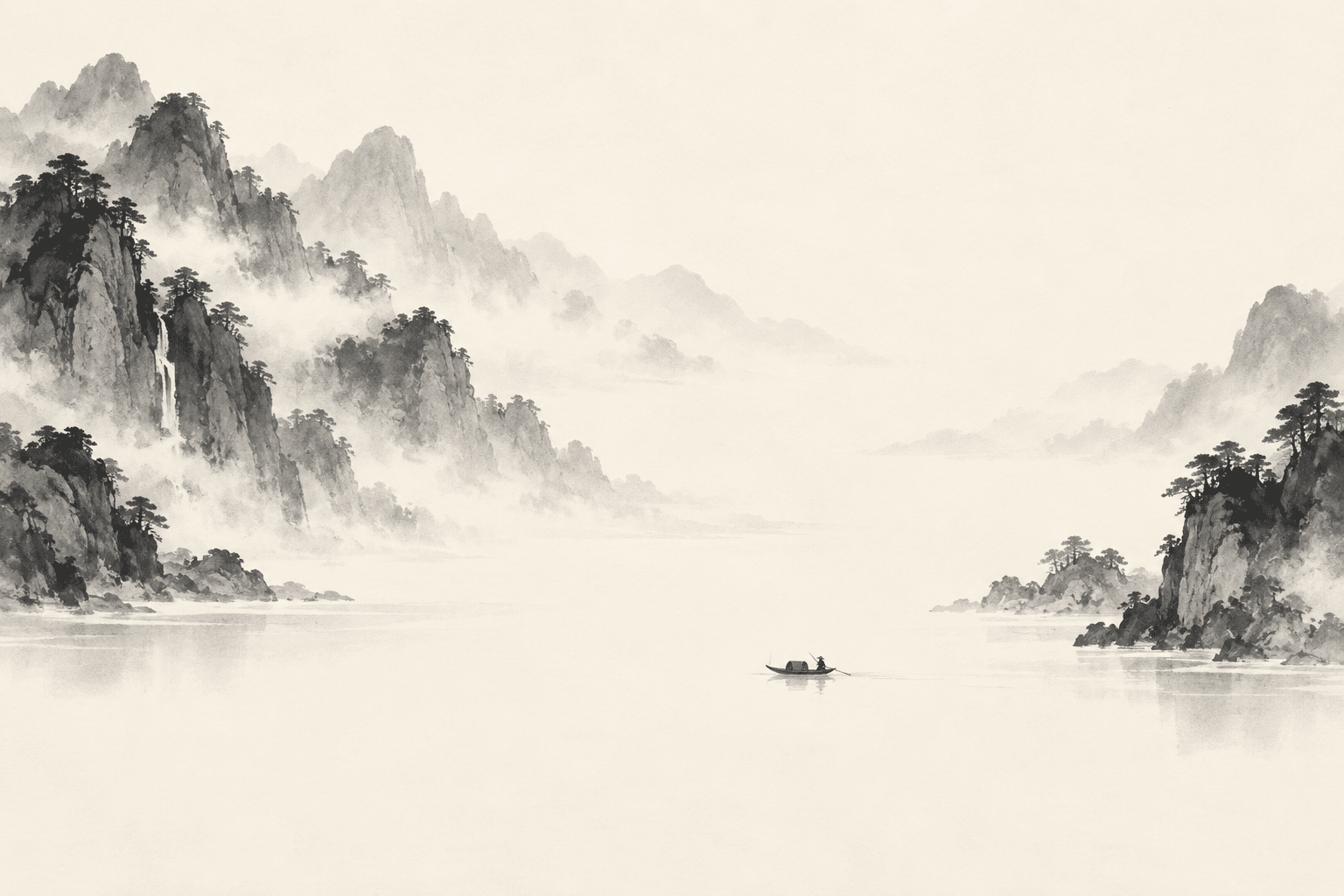
An unpainted area of a landscape is easy to mistake for something unfinished. Look longer. The white paper between two inked banks may become a river; a pale gap around a mountain may feel like mist. Blank space gives the visible marks room to describe what cannot be outlined directly.
Start with the edges
Trace the line where painted land meets open paper. Does the edge slope like a shore, dissolve into a wash, or disappear behind trees? The surroundings offer clues about whether you are seeing water, atmosphere, sky, or an undefined interval. You do not have to assign one fixed meaning to every gap.
In Chinese painting, an image may invite a viewer to imagine moving through a place instead of surveying it from one fixed point. The Met’s guide to reading Chinese paintings describes landscapes as places a viewer might mentally walk through, ramble in, or dwell in. Open areas can make that imagined movement possible. A misted valley can separate a near tree from distant peaks without drawing every intermediate slope.
Test the space by changing your pace
First look at the painting from a distance: where does your eye pause? Then examine a small detail. A boat in an expanse of pale paper can establish the scale of water; a faint ridge can make blankness feel atmospheric. Finally, step back. Notice whether the apparent emptiness now connects the painted forms.
This is a way of looking, not a universal code. Some blank areas are compositional choices, and reproduction cropping can change their effect. When comparing prints, check that margins and proportions have not been altered so heavily that the balance of ink and open paper is lost.
Explore next: A beginner’s guide to shanshui and how mist creates distance.