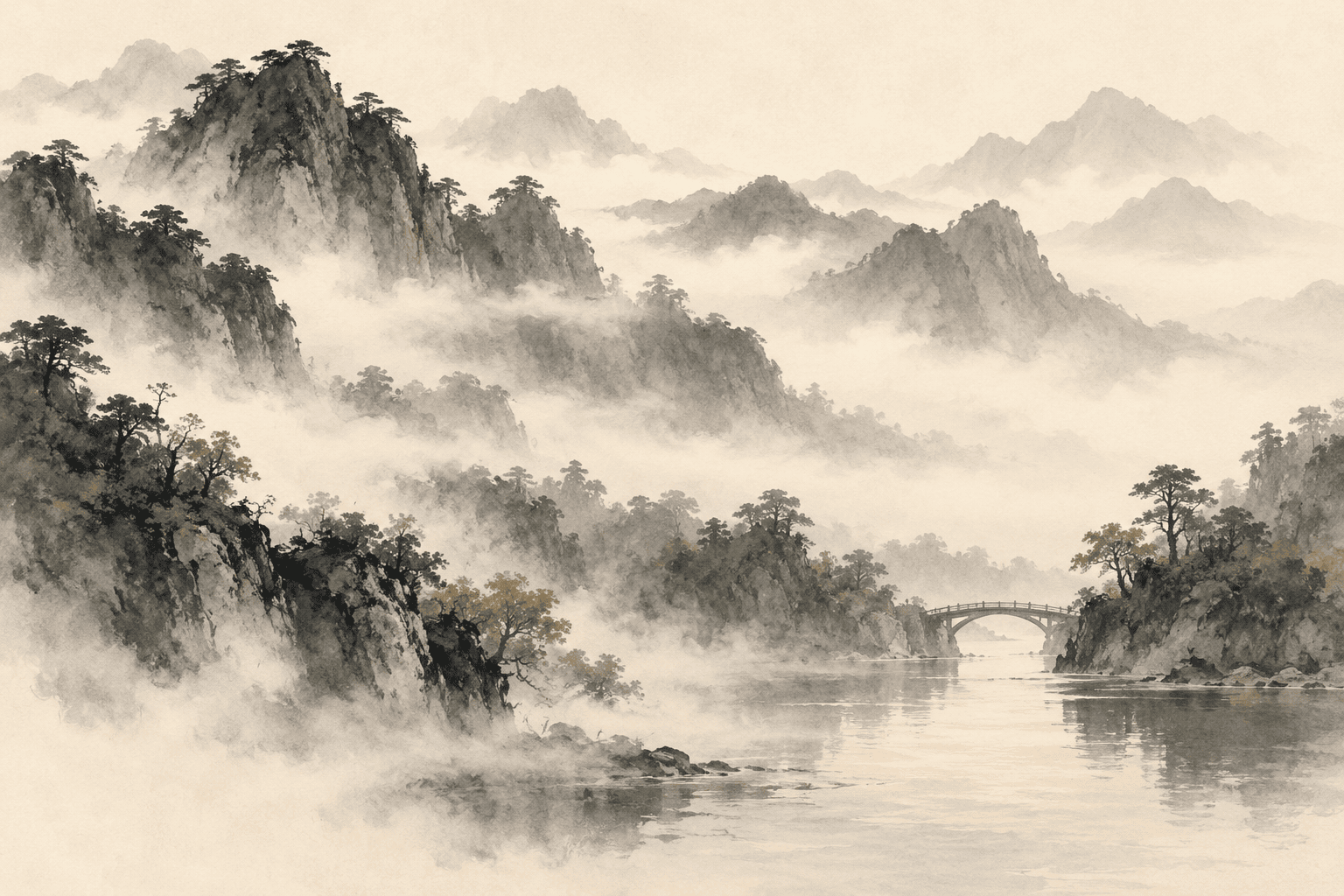
Mist is more than weather in a Chinese landscape. It can separate one ridge from another, interrupt a path, and leave room for a viewer to imagine what lies beyond. Its practical visual effect is to make space feel layered without drawing every inch of it.
Follow what disappears and returns
Start with a dark foreground tree or rock. Look behind it for a lighter slope. Then find the place where a ridge fades into pale paper or wash. Your eye may continue across that gap and meet another mountain farther away. The transition can be softer than a hard outline, but it still gives the painting structure.
Guo Xi’s landscapes are useful for noticing such transitions. The Met discusses his attention to nuances of season and time of day, and its record for Old Trees, Level Distance shows a broad valley beyond foreground trees. Mist and pale intervals can encourage a slow passage across that space.
Keep observation separate from interpretation
A misty scene may suggest a mood, but it does not carry one automatic philosophical message. Look for evidence in the composition, title, and inscriptions before making a larger claim. The Met notes that landscape atmosphere and season could convey different moods and associations in different works.
On a screen, excessive contrast or a poor print can erase faint washes and turn a layered scene into empty white. If you are comparing reproductions, inspect the midtones, not just the darkest brushstrokes.
Explore next: Blank space in Chinese landscape painting and Guo Xi’s Early Spring.