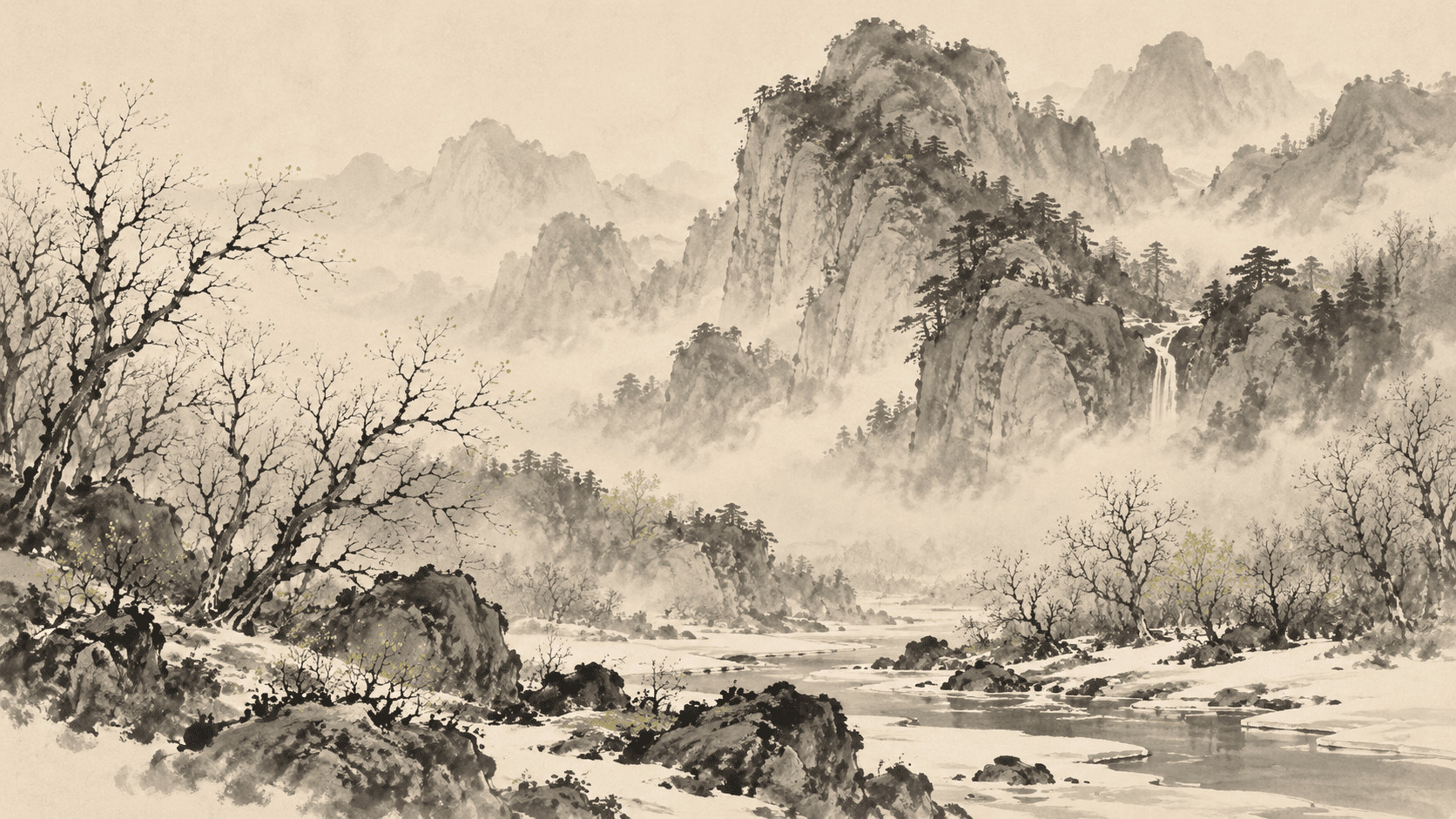
Early spring is a season of almosts. The ground is changing, but it has not turned green. Water begins to move. Trees are still spare. Guo Xi’s Early Spring makes this unsettled moment feel immense.
The painting is dated 1072 and held by the National Palace Museum, Taipei. The museum identifies it as a silk hanging scroll by Guo Xi, measuring 158.3 by 108.1 centimetres. Its title and date appear in the artist’s inscription. These are historical facts; the sense of awakening that viewers may feel is an interpretation of the painting’s visible choices.
Begin with the mist
At first glance, the mountain seems to rise in one continuous movement. Look again and mist interrupts it. Some forms sharpen; others nearly disappear. This creates distance without drawing a tidy line between foreground and background.
The museum describes Guo Xi’s graded ink washes as a way to create light, dark and a sense of space. Its commentary also points to “cloud-head” texture strokes in the mountain and branching tree forms. You do not need to know the technical names to see the effect: the landscape seems to emerge and recede while you look.
Find the signs of life
The picture is not only rock and weather. The National Palace Museum notes boating, gathering firewood and travel within the composition. These activities are easy to miss when you focus on the mountain. Finding them changes the painting from a distant view into a world with human movement.
A small figure also changes your pace. You pause to ask where a person might go, what path they could follow, and how far the mountains extend beyond them. That is one way a landscape invites you to imagine being inside it.
Compare atmosphere with scale
Guo Xi’s painting is often discussed alongside Fan Kuan’s Travelers Among Mountains and Streams. The National Palace Museum’s collection notes contrast Fan Kuan’s solemn mountain with Guo Xi’s shifting spring atmosphere. The comparison is useful because both works are monumental, but they do different things with that size. In Early Spring, the mountain is never entirely fixed; mist and wash make it changeable.
A digital image can help you inspect these details, but avoid judging the painting from a high-contrast thumbnail alone. Pale washes and quiet transitions may disappear on a small screen. Give the image room, zoom gradually, and return to the full composition after studying details.
Let the season remain open
It can be tempting to turn spring into a ready-made message of renewal. The painting offers more nuance. Its bare trees, moving water and unstable mist describe transition without declaring that it is complete. That ambiguity is part of what makes looking at it rewarding.
Continue exploring: Read HUALI’s Early Spring story page, and compare it with Fan Kuan’s monumental landscape.