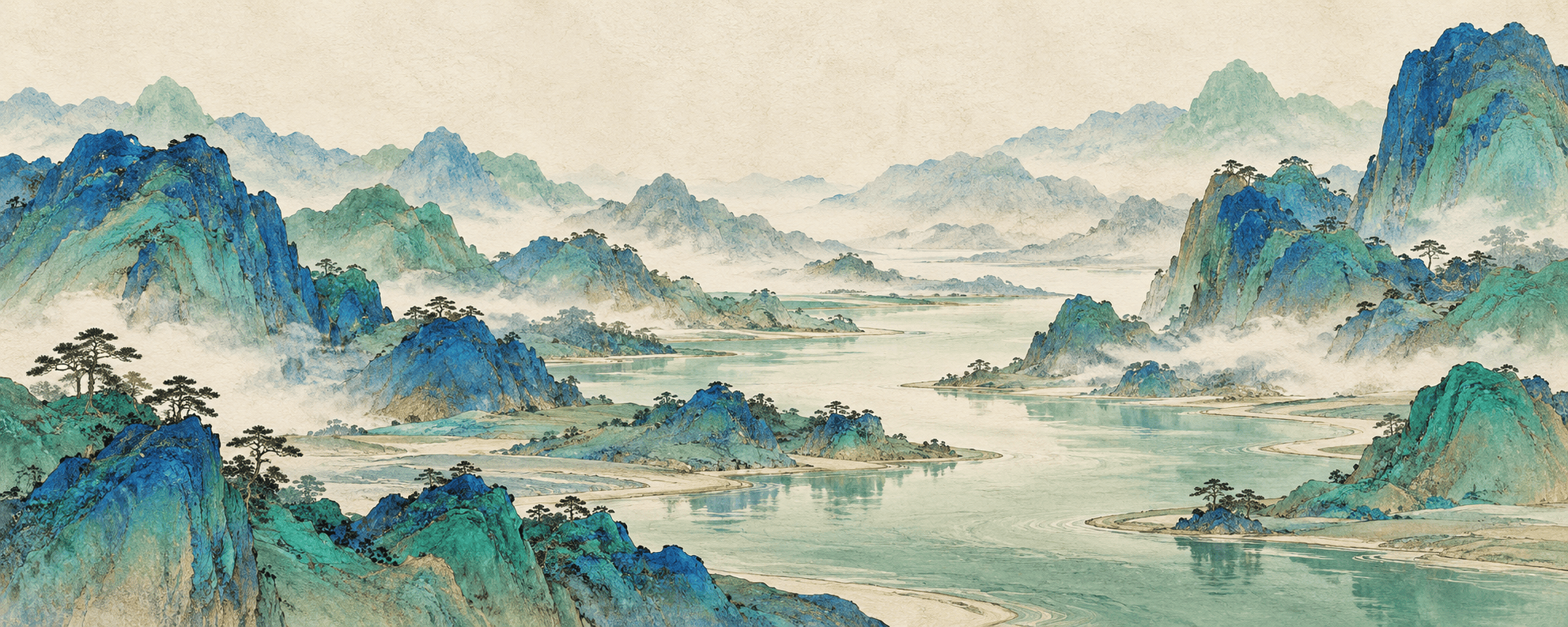
Chinese landscape painting is often associated with black ink and mist. Yet another tradition is dazzling in blue and green. Mountains glow with colour; waterways carry the eye between them. This is qinglü shanshui, usually called blue-green landscape painting in English.
The Palace Museum explains that blue-green shanshui takes its name from blue and green mineral or plant pigments. The tradition developed through earlier painting and was further refined by artists of the Song dynasty. Colour is therefore part of a long artistic practice, not a modern addition to make an old image feel brighter.
What does “shanshui” mean?
Shan means mountain; shui means water. Together, the characters name a landscape tradition built around the relationship between these forms. A painting need not behave like a photograph of one place. Mountains may rise from several viewpoints, while water can join separate passages of the picture.
The Metropolitan Museum of Art notes the literal meaning of shanshui and the importance of water within Chinese landscape imagery. For a first encounter, it helps to ask what the mountain holds still and where the water invites movement.
Look past the colour first impression
Blue-green painting can seem decorative from a distance. Move closer and the composition becomes more active. Watch how coloured ridges overlap, where lighter spaces let the eye rest, and how paths, bridges and buildings establish scale. A large area of blue may feel continuous, but small differences in tone can separate one mountain plane from another.
Wang Ximeng’s A Thousand Li of Rivers and Mountains, preserved by the Palace Museum, is a useful example. The museum identifies it as a major Northern Song blue-green handscroll. In its collection record, it describes a sequence of peaks, rivers, buildings, bridges and small figures. Colour helps hold this very long composition together while the details keep it varied.
Colour is not a fixed promise
It is easy to attach a simple modern meaning to blue and green—calm, luck or prosperity. Those reactions can be personal, but they should not be presented as a historical guarantee attached to every painting. The more useful questions are visible: how are the colours applied, how do they structure space, and what changes as the viewer moves through the work?
If you are choosing a reproduction for your home, study the actual image rather than a heavily filtered preview. Consider where detail may disappear at small print size, and whether the selected crop preserves the relationship between mountain and water. That attention does more justice to the painting than a generic colour label.
Continue exploring: View HUALI’s A Thousand Li of Rivers and Mountains story page, or start with our guide to reading Chinese landscape painting.