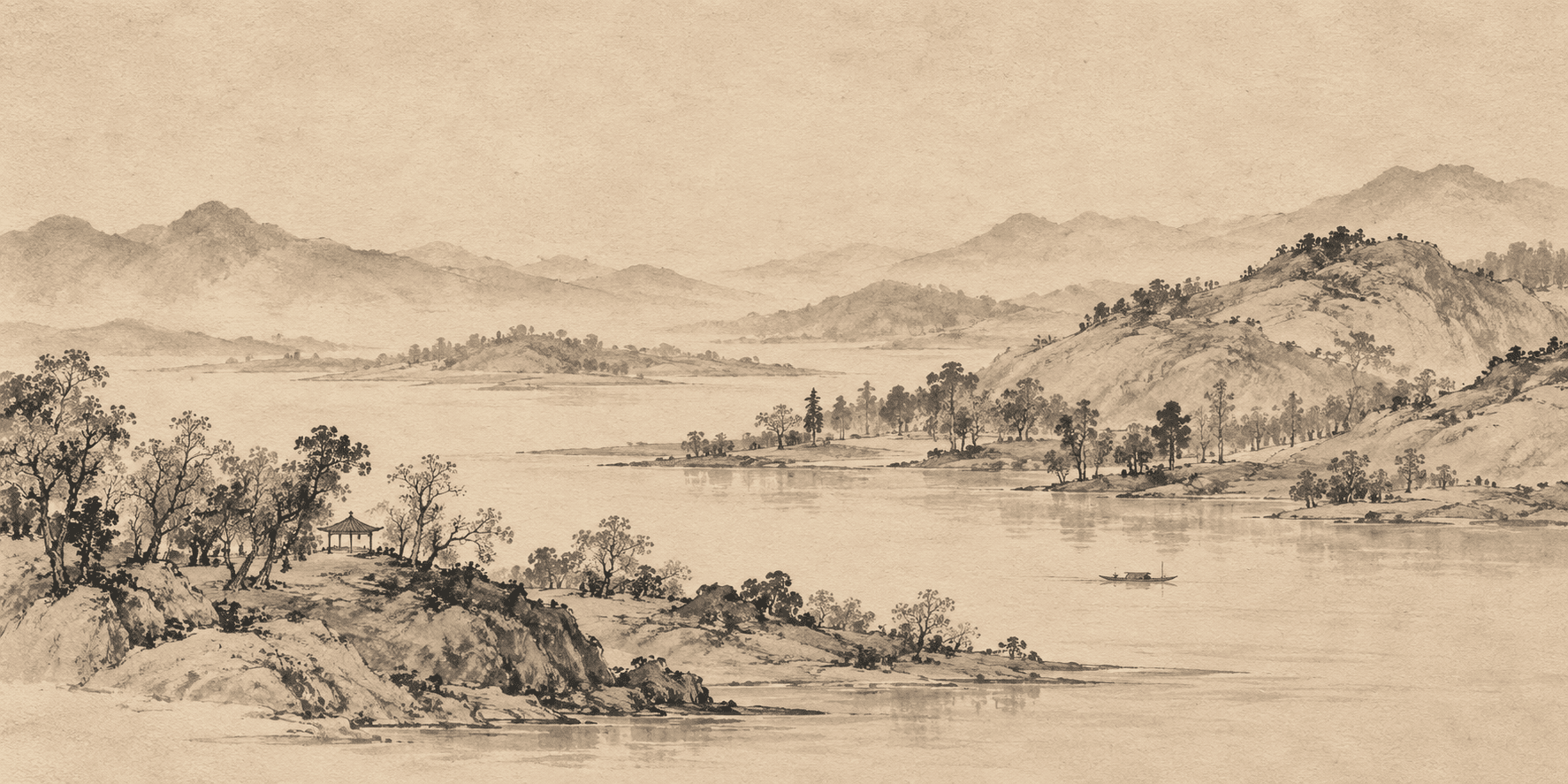
At a distance, an ink landscape can seem to use only one colour. Look longer and the range expands. A dark outline, a dry textured stroke, a soft wash and a nearly untouched patch of paper do different jobs. Together they can make a hill feel close, another feel distant, and a river feel open.
Huang Gongwang’s Dwelling in the Fuchun Mountains offers a particularly rich way to notice this. The National Palace Museum in Taipei identifies its Master Wuyong Scroll as a Yuan dynasty work completed around 1350. The painting is a handscroll on paper, more than six metres long in its surviving form. The museum describes layered brush and ink, with mountain forms that shift from rounded near hills to gentler banks and taller peaks. National Palace Museum collection record
Follow the changes in tone
Start with one small section. Which marks are darkest? Where is the paper left light? Dark ink can establish an edge or a cluster of trees. A pale wash can let a hill retreat without making it vanish. The contrast does not need to be dramatic to create depth.
Try moving your eye between two similar hills. One may be defined by a firm contour; another by layered texture. The variation keeps the scroll from feeling mechanically repeated. You are seeing decisions made through the brush, not simply a monochrome version of a colourful scene.
Notice the space between marks
The unpainted or lightly painted areas matter as much as the dark strokes. They can make room for water, air or distance. If you are viewing a reproduction on a bright screen, reduce the temptation to push contrast until every faint wash looks black. Subtle tonal differences are part of the work.
The handscroll format also shapes the experience. As the Metropolitan Museum of Art explains, a handscroll is encountered as a continuous roll rather than one image presented all at once. With Huang’s painting, the changing hills and banks reward a measured pace. Pause, then move to the next passage.
A landscape with a complicated material history
The painting’s physical history is part of its story. The National Palace Museum notes that the scroll suffered a fire in 1650 and that its first section was cut off; that separated part is now held by the Zhejiang Provincial Museum. This is a reason to be precise when a digital image is described as “complete.” Which surviving section does it show? Has it been cropped? Is it a study image or a print file?
The museum’s account also says Huang began the scroll after returning to Fuchun in 1347 with his friend Zheng Wuyong and worked on it over several years. That history does not dictate how a modern viewer must respond. It does remind us that the image was built gradually, through observation, memory and repeated work.
Give the quiet details time
An ink landscape does not need bright colour to hold attention. Look for a shift in pressure, a tree drawn with a few marks, a riverbank that opens unexpectedly. The more you notice those decisions, the less “minimal” the painting feels. Its economy makes room for variation.
Continue exploring: See HUALI’s Dwelling in the Fuchun Mountains story page, and begin with the currently published guide to reading Chinese landscape painting.