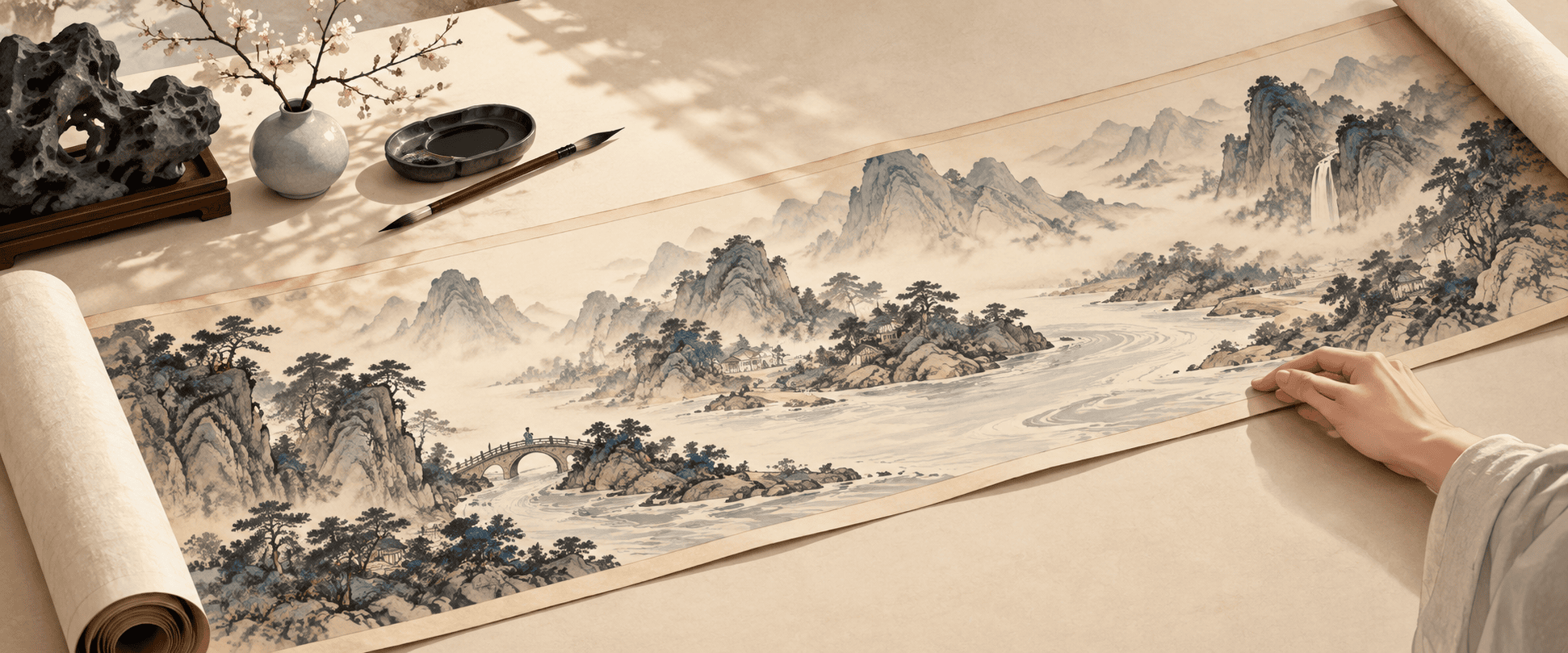
A long Chinese landscape can be tempting to take in with one glance. On a phone, the whole work may be reduced to a thin strip. In a museum image viewer, you may be able to zoom from end to end in seconds. But the handscroll was made for another pace: one section opened, another still waiting.
The Metropolitan Museum of Art describes the handscroll as a continuous roll of paper or silk that remains rolled when it is not being viewed. That physical form matters. A handscroll does not present its entire landscape at once. It lets the viewer encounter a sequence.
Follow what connects the scenes
Begin with a small area rather than the full image. Look for a river, path, bridge or line of trees. Where does it lead? A bridge may join two stretches of land; a bend in the water may carry your eye around a ridge. These details help separate passages feel like one journey.
This is especially useful with Wang Ximeng’s A Thousand Li of Rivers and Mountains. The Palace Museum’s collection record describes bridges and waterways linking the work’s landscape sections. Its mountains rise and fall across a long blue-green scroll. The experience is less like standing before one framed view and more like moving through several related views.
Let the scale change
Look first at the largest forms: mountains, waterways, open sky. Then look for boats, houses and figures. Their small size changes your sense of the landscape. They also offer a human route through an image that might otherwise seem impossibly vast.
You do not need to find a single hidden message in each detail. Notice how your attention moves between the large and the small. That shift is already part of the pleasure of looking.
A useful way to view a handscroll online
If a digital image allows it, zoom in enough to see a comfortable section. Move slowly in one direction. Pause at a bridge, a boat or an opening between mountains. Then step back and see how that passage belongs to the whole. When you return to the beginning, you may notice a rhythm you missed in the full-width thumbnail.
A digital reproduction is a way to study an image, not a substitute for the original object and its materials. Image resolution, colour and cropping can all affect what you see. If you are considering a print, check whether it shows the complete composition or a clearly identified detail, and make sure the proportions have not been stretched.
Continue exploring: Read the HUALI story of A Thousand Li of Rivers and Mountains and compare its long format with other works in the collection.