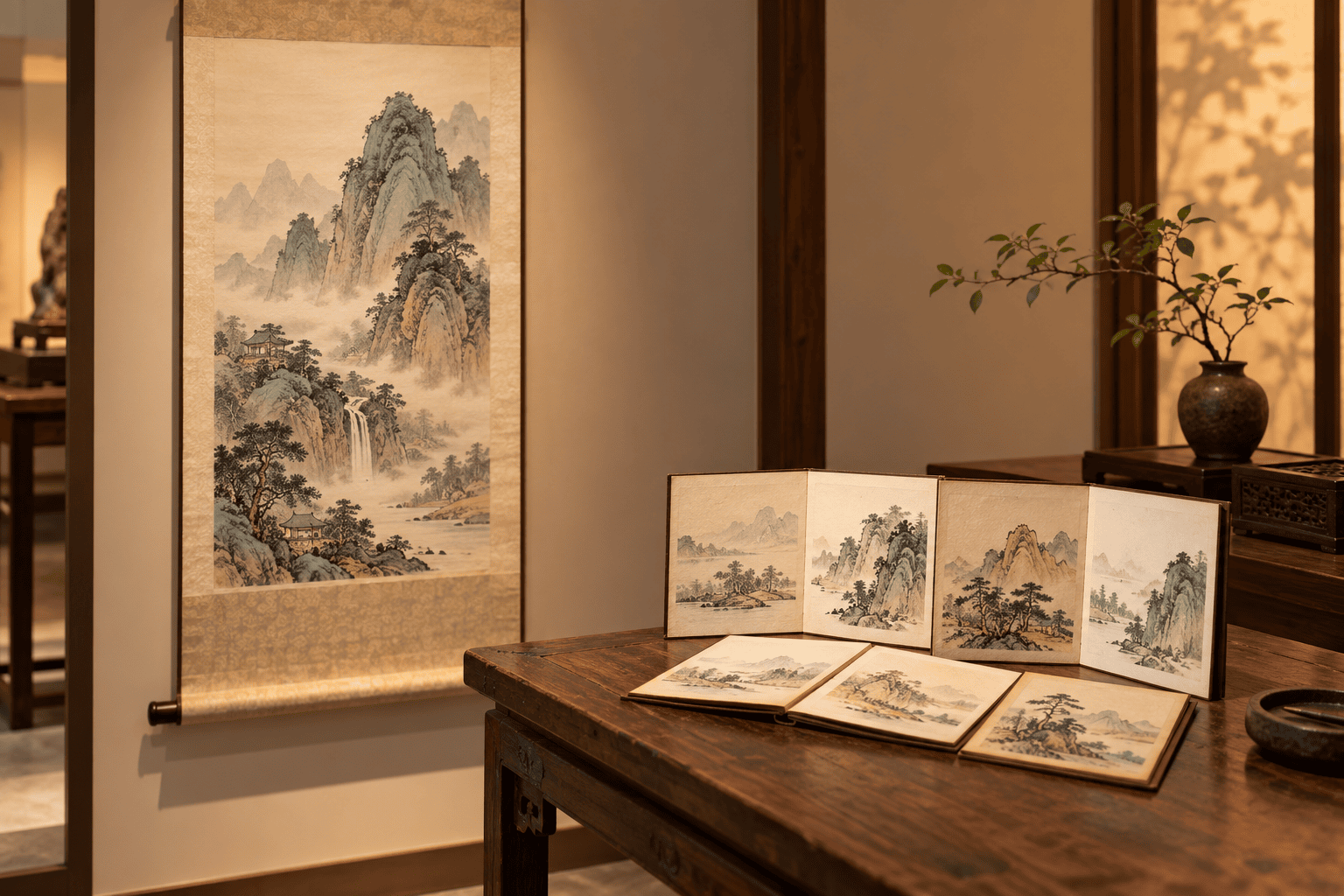
The subject of a Chinese painting tells only part of its story. Its format determines how a viewer meets it. The Smithsonian National Museum of Asian Art identifies three major traditional formats: handscrolls, hanging scrolls, and album leaves. They are different viewing experiences, not merely different aspect ratios.
The handscroll: a journey in sections
A handscroll lies horizontally and is opened gradually on a table, traditionally from right to left. Only a portion is visible at one time. Its long shape can hold changing scenes, writing, and later responses. A full-width thumbnail is useful for orientation, but it compresses the original pace of viewing.
The hanging scroll: a composed view
A hanging scroll is displayed vertically. You can see its overall composition at once, then look up and down to study details. The proportions may emphasize a towering peak, a tree, or an open sky. Its mounting is part of the object, although online images sometimes crop it away.
The album leaf: an intimate encounter
Album leaves are smaller works gathered into a book-like form. They can reward close, individual looking and may be paired with writing. Their compact scale can be lost when an online image fills a monitor as if it were a monumental wall work.
When choosing a reproduction, check the original format and dimensions. A handscroll detail printed as a square should be described as a detail; a hanging scroll should not be stretched to fit a frame. Knowing the format helps you judge whether a reproduction preserves the work’s character.
Explore next: How to view a handscroll and how to choose a landscape print.