Why does Ni Zan’s landscape look so sparse?
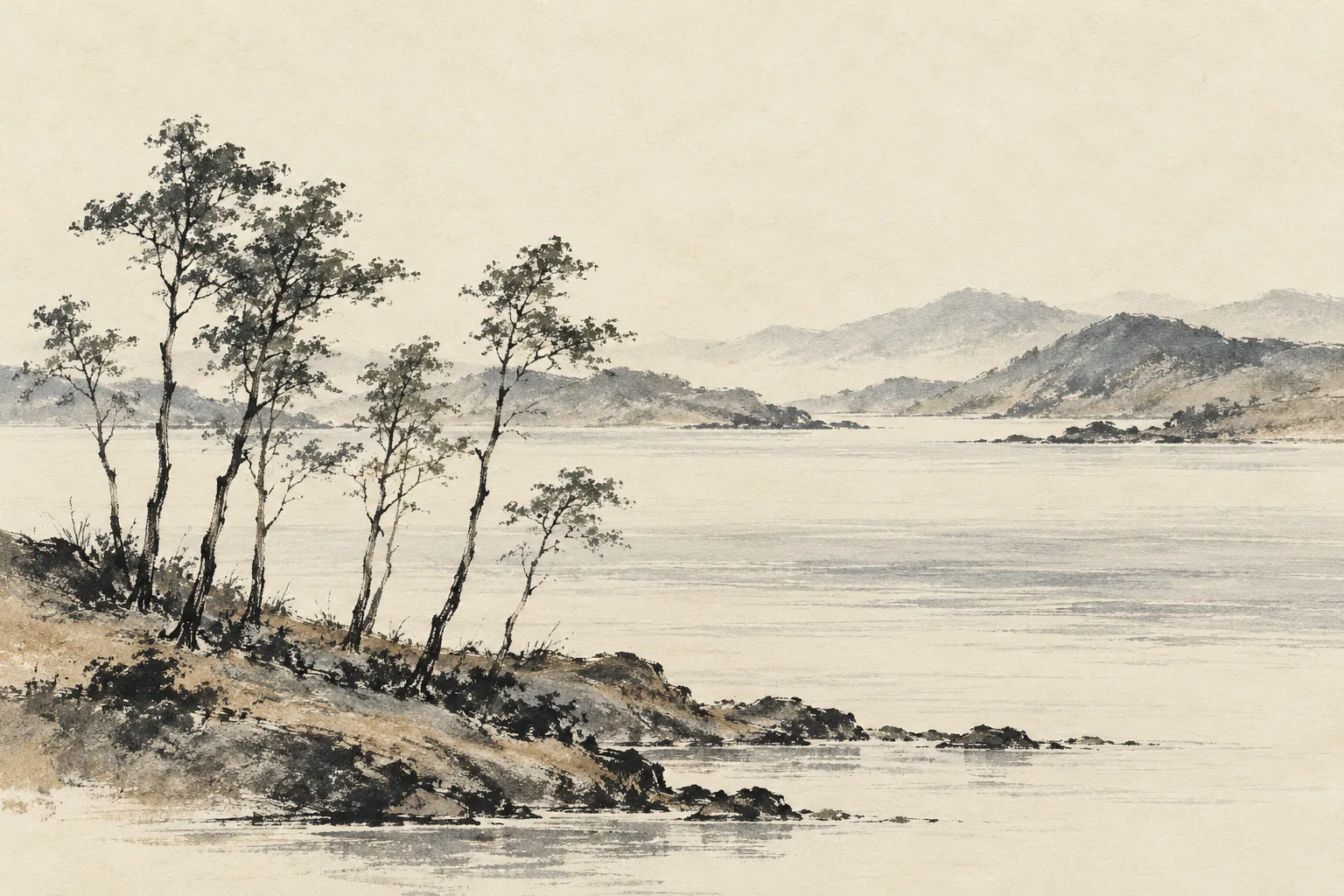
A useful way to approach Ni Zan’s Rongxi Studio is to look at the relationships between a few elements: a near bank, trees, open water and a distant shore. The space between them gives each mark a distinct role. You do not need to fill that space with an imagined missing scene.
The National Palace Museum describes the painting’s arrangement as a river between two banks. Its label also explains that the title comes from an inscription mentioning Pan’s residence, Rongxi Studio. This is a reminder to distinguish a painting’s title from a literal inventory of everything visible in it. National Palace Museum: Rongxi Studio.
Look in three passes
First, locate the shores. Let your eye move from the nearer ground toward the farther strip of land. Before inspecting details, ask how much of the picture is occupied by the interval between them. Try looking from farther away from your screen; the large divisions may become easier to see.
Next, follow the trees. Trace their trunks upward and notice where branches interrupt the open area. Compare the trees as a group, then individually. This exercise shifts attention from identifying objects to seeing differences in placement and direction.
Finally, study a small patch of brushwork. Compare a dark edge with a lighter passage. Describe what you see before assigning a mood: broken, continuous, light, dense, angled or upright are useful starting words. “Quiet” can be your response to these relationships, rather than a claim about the artist’s private feelings.
Is this the same as modern minimalism?
“Minimal” can describe a present-day viewer’s impression, but it should not replace the work’s own historical context. Start with the museum’s title and attribution, then separate your personal comparison from documented facts. Sparse composition alone does not identify an artist or establish an artwork’s authenticity.
Comparing it with a denser landscape
Open a detailed mountain painting beside it. Alternate between the two without deciding which is better. Where does each image ask your eye to stop? Which forms connect near and far? This comparison makes restraint easier to notice than simply counting how many objects a painting contains.
Continue with our guide to the three distances and blank space in landscape painting. Browse the collection to practice these looking questions on other works; this article does not imply that Rongxi Studio is offered for sale.