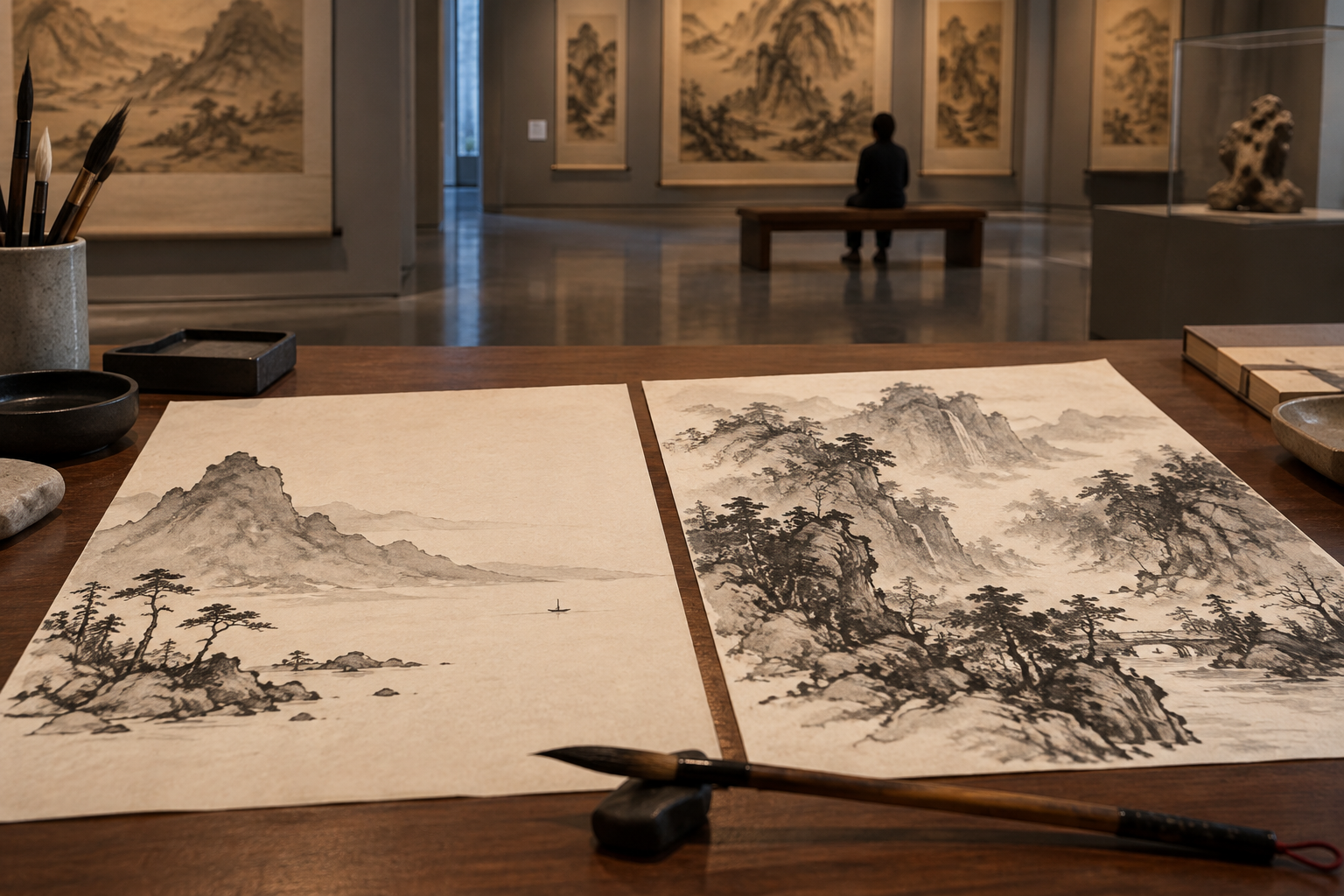
An artwork described as “after” an earlier painter can sound like a lesser version of an original. That assumption makes it harder to understand Wang Hui. The Qing artist studied older landscape styles intensively, but the Met describes his work as an inventive dialogue with the past, in which familiar methods become a new composition.
What was Wang Hui learning?
He studied patterns of foliage, rock texture, and the organization of mountains and valleys. The Met compares this process with a calligrapher learning earlier models, expanding a repertoire, then arriving at a personal synthesis. That comparison helps explain why brushwork mattered as much as subject matter. Two paintings can show mountains while making those mountains with very different lines.
Wang Hui also made close interpretations of earlier works. The museum notes that some bore his own signature and date; they were not necessarily attempts to conceal their maker. Nor were they simple line-for-line replicas. Look for what he kept, changed, or combined.
Try a side-by-side reading
When a museum provides the model and Wang's version, begin with large shapes. Has a mountain moved? Is an empty interval wider? Then inspect the small marks: are the texture strokes tighter, looser, darker, or more rhythmic? Finally, read the catalogue entry to see whether “after” refers to a specific work, an artist's style, or a broader tradition. Those are different claims.
The Met's record for Clearing after Rain over Streams and Mountains describes Wang combining motifs associated with earlier masters into a clouded landscape of his own. It offers a concrete example of transformation rather than duplication.
Keep authorship precise
An “after” work should be credited to the later artist when that is the museum's attribution. A modern print of it is another object again. Clear labels help a viewer understand both the historical conversation and what is being reproduced today.
Explore next: Literati and court painting and Shen Zhou’s autumn handscroll.