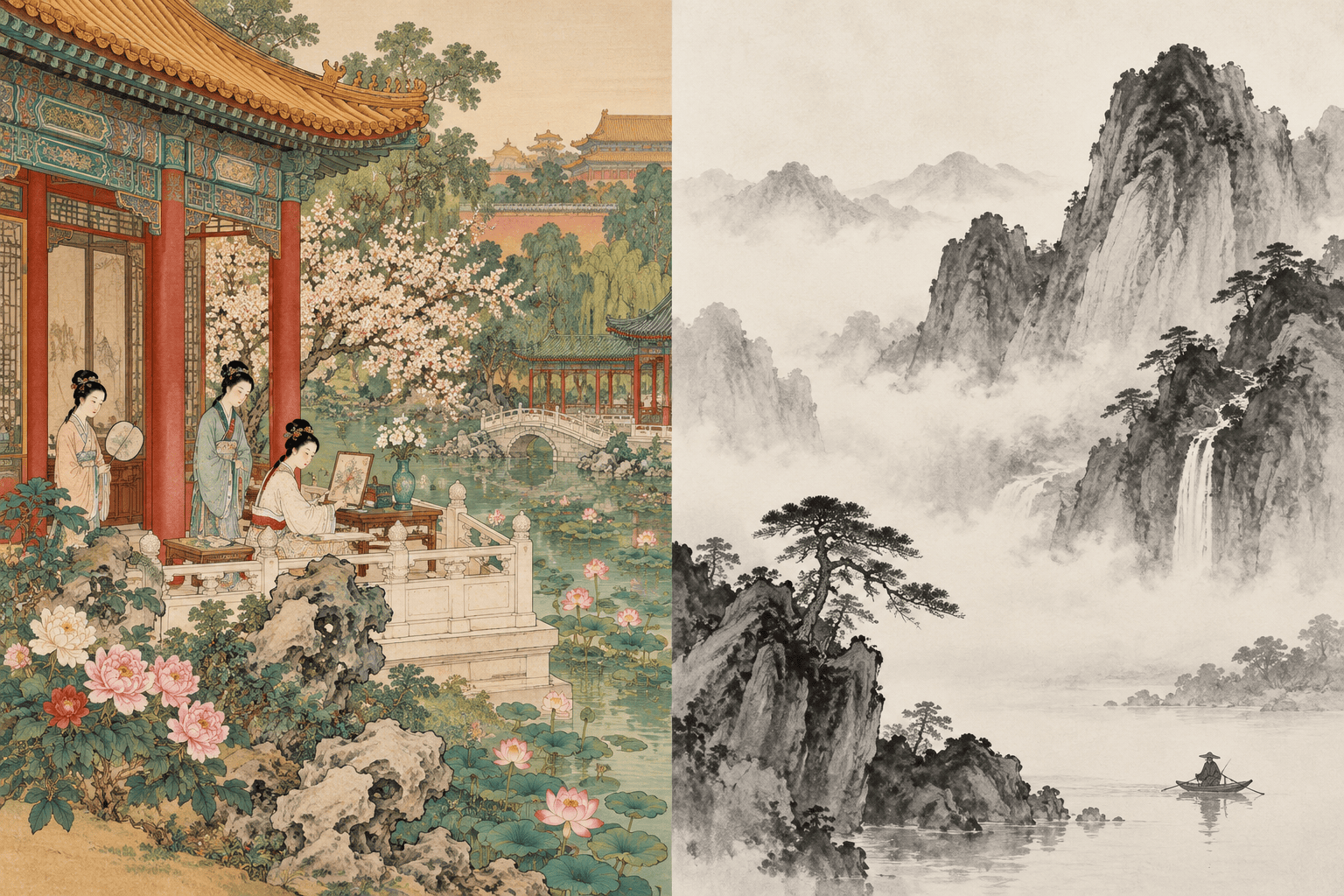
“Literati” and “court” are useful words in Chinese art history, but they do not describe two sealed-off styles. Literati painting is associated with educated scholar-artists and the expressive use of brushwork; court painting was made in relation to imperial patronage and could favor different forms of skill and representation. The distinction concerns makers, audiences, and artistic aims as well as appearance.
What to look for
In a scholar’s ink landscape, you may notice strokes that resemble handwriting, references to earlier painters, and a poem or inscription. The Met’s overview of landscape painting explains how scholar-artists could use landscape to express cultivated identity and feeling, not simply describe a location.
Court commissions might involve a polished finish, color, narrative, or celebration of an ideal order. Yet those are tendencies, not tests. The Met’s account of Ming art contrasts professional representational traditions with the calligraphic idiom of scholar-amateurs while showing both within one period.
Why the labels need care
An artist could work across settings, borrow older styles, or answer more than one audience. A colorful painting is not automatically a court work; monochrome ink is not automatically literati. Start with the object record: who made it, who commissioned or received it, and what inscriptions survive? Then ask how brushwork, composition, and material support that history.
For a helpful comparison, look at two museum works side by side and describe what each asks you to notice. That gives the labels a purpose without flattening the variety of Chinese painting.
Explore next: Ink wash in Dwelling in the Fuchun Mountains and poetry and inscriptions.