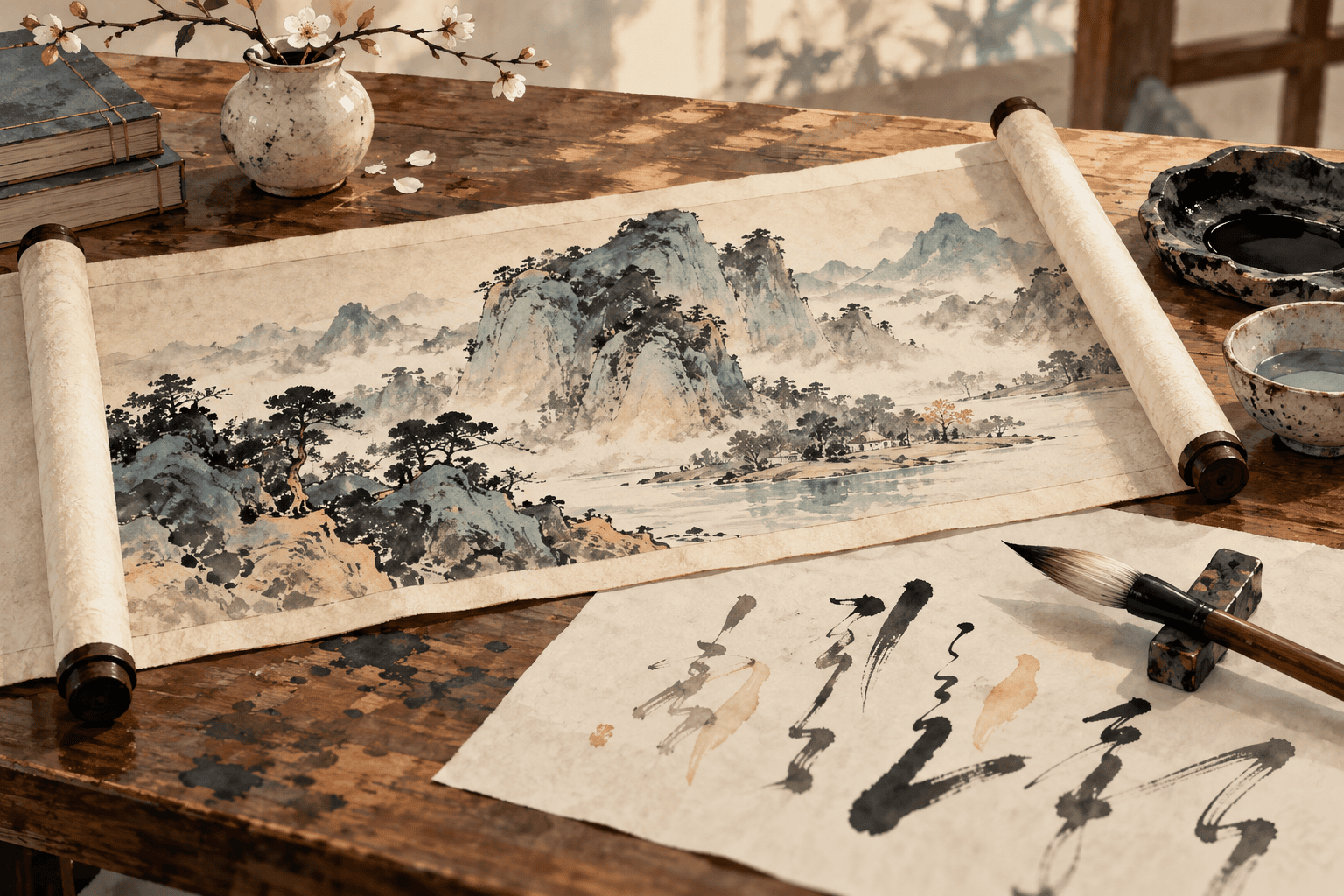
The writing beside an ink landscape is often part of the work’s experience. It might be the painter’s poem, a note about when or for whom the painting was made, or a later viewer’s response. The first question is not “what does it translate to?” but “who wrote it, and when?”
Look for several voices
The Met explains that handscrolls can carry text before or after the painted image. A colophon is commentary added on an attached section; it may come from a friend, collector, or someone who encountered the work centuries later. Such writing can preserve the circumstances of making or viewing a painting, but it can also express a later person’s opinion.
Artist inscriptions are different from later additions. Some combine a date, place, dedication, and poem; others may be short. The Met’s account of Chinese painting describes poetry, calligraphy, and painting working together in the scholar tradition. Brush lines in the text can matter visually even before a reader knows the words.
Read with the museum record
Start with the catalogue entry’s “inscriptions” section if one exists. It can tell you which text belongs to the artist, which was added later, and whether a translation is available. Then return to the image. Does the writing balance a mountain, frame an open sky, or pull your eye toward a seal?
Avoid assuming that every inscription is a caption explaining what the picture shows. It may instead be a poem, a personal address, a historical note, or a conversation with an earlier painter. That variety is part of why Chinese painting can feel like something to read as well as see.
Explore next: What red seals mean and how to view a handscroll.