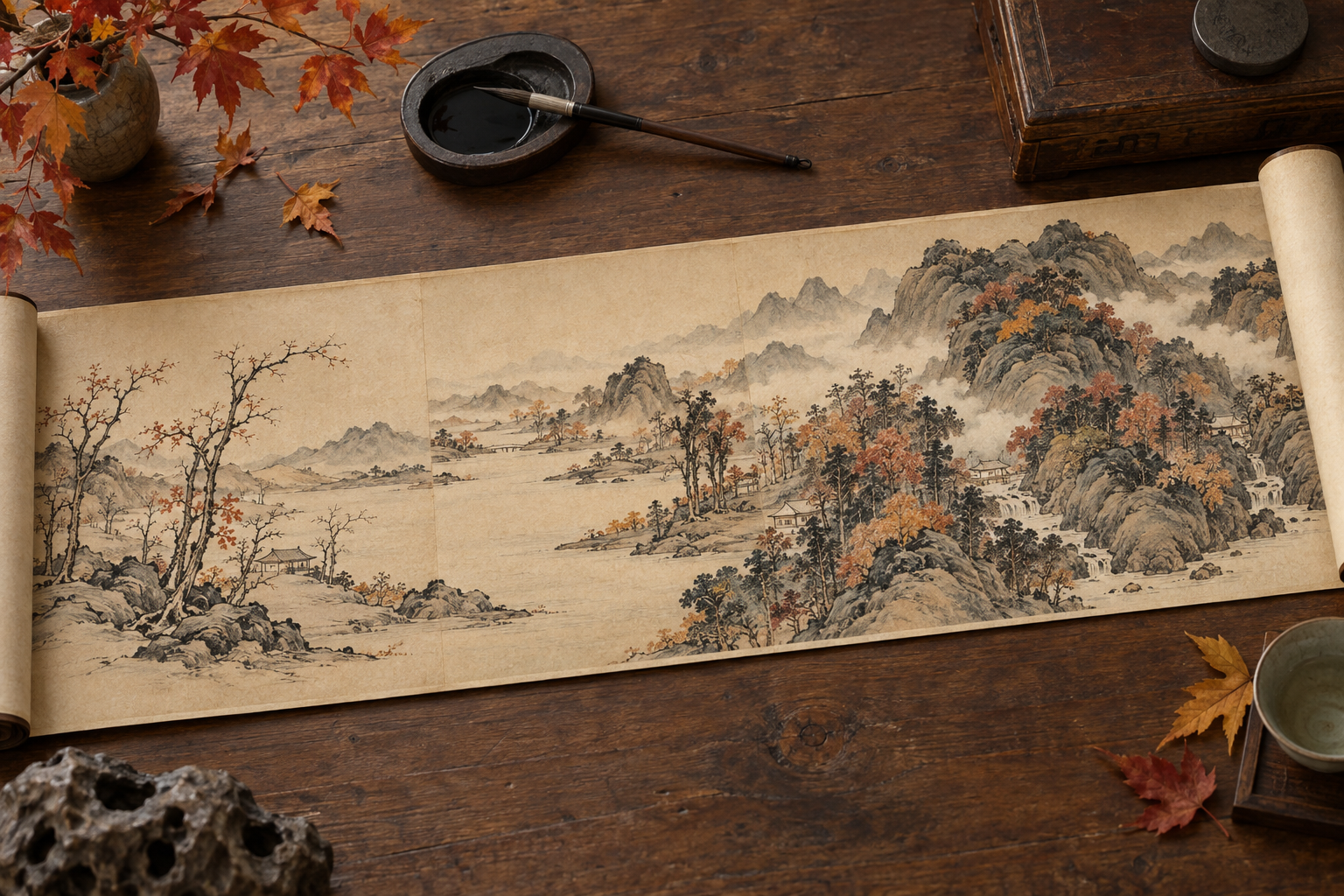
Shen Zhou's Autumn Colors among Streams and Mountains is an unusually long invitation to notice brushwork change. The Met dates the handscroll to about 1490–1500 and identifies its medium as ink on paper. Rather than looking for a single “best” view, follow the scroll as a series of deliberate shifts.
Begin with spare forms
The Met describes the opening as recalling the Yuan painter Ni Zan: sparse trees, bare rocks, and an empty pavilion. Pause over how little is needed to suggest a place. A tree trunk, a low bank, and open paper can create a convincing interval without filling every part of the scene.
Watch the strokes become denser
As the scroll continues, Shen moves through brush idioms associated with Huang Gongwang and Wang Meng. The Met points to longer texture patterns, then rounded, curling, and stippled strokes. Compare a rocky slope near the beginning with one farther along. The shapes change, but so does the pace of your looking. A dense section asks you to inspect many marks; a spare section leaves room for the eye to rest.
The closing passages evoke Wu Zhen through rounder banks and stockier trees. This is not four separate paintings pasted together. Shen's sequence lets one autumn subject carry different moods and references.
Why quoting the past matters
For a Ming scholar-artist, earlier painting styles could be a language to work with. The Met's overview of landscape painting describes learned references and calligraphic brushwork as important to this tradition. Shen demonstrates that looking backward could also be a way to vary a new work.
On a screen, move slowly from right to left and compare one section with the next. If you only view the entire scroll as a narrow strip, you will miss the local differences that make the work rewarding.
Explore next: How to view a handscroll and Huang Gongwang’s ink wash.