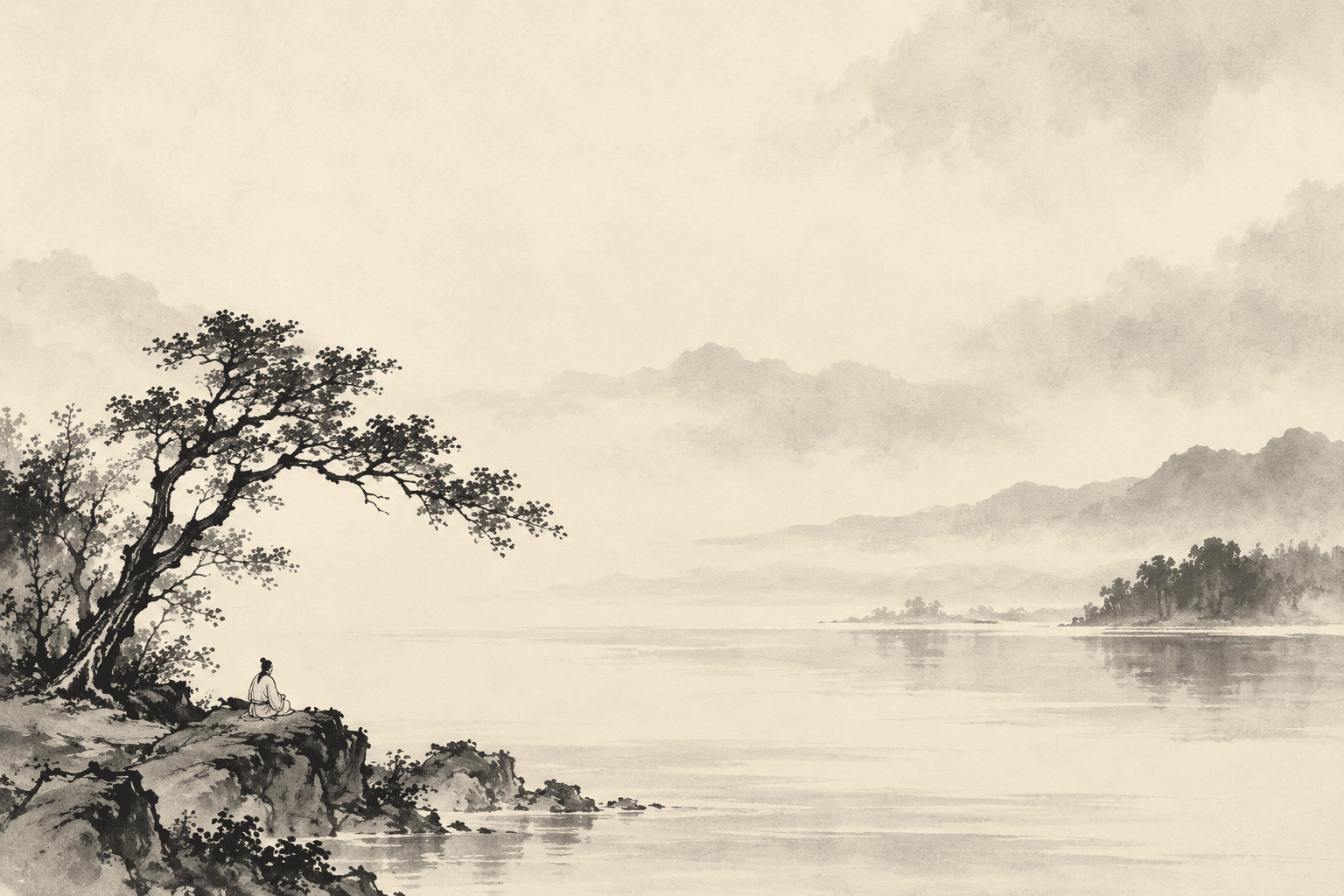
Some landscapes draw attention by filling the frame. Others concentrate a tree, figure, or rocky bank in one area and leave the rest open. Ma Yuan, an important painter at the Southern Song academy, is associated with such focused compositions. The Met identifies him as a leading artist in the academy at Hangzhou and records Scholar Viewing a Waterfall as an album leaf on silk.
Begin with the painted corner
Look for the densest cluster of forms: perhaps a figure beneath a tree or a bank beside water. Then ask where the person is looking. The open area may become the subject of that gaze. In this way, the viewer’s attention can move beyond the painted objects even though the sheet itself is still.
The effect depends on scale. In an album leaf, a small figure and a broad pale passage invite close looking. On a screen, the same image can be enlarged so much that its original intimacy disappears. Check the museum record for format and dimensions before comparing it with a wall-size print.
A useful comparison, not a fixed formula
“One-corner” is a shorthand for a family of selective compositions, not a rule that every work by Ma Yuan follows. Avoid treating blankness as a single philosophical message. Look at the particular painting: where are the visible forms, what do they frame, and what does the title or inscription add? The Met’s reading guide places Ma Yuan within Southern Song academy painting and offers individual works for comparison.
If you return to the image after following these questions, open space may feel less like missing detail and more like a deliberate invitation to look.
Explore next: Blank space in Chinese landscape painting and album leaves versus scrolls.