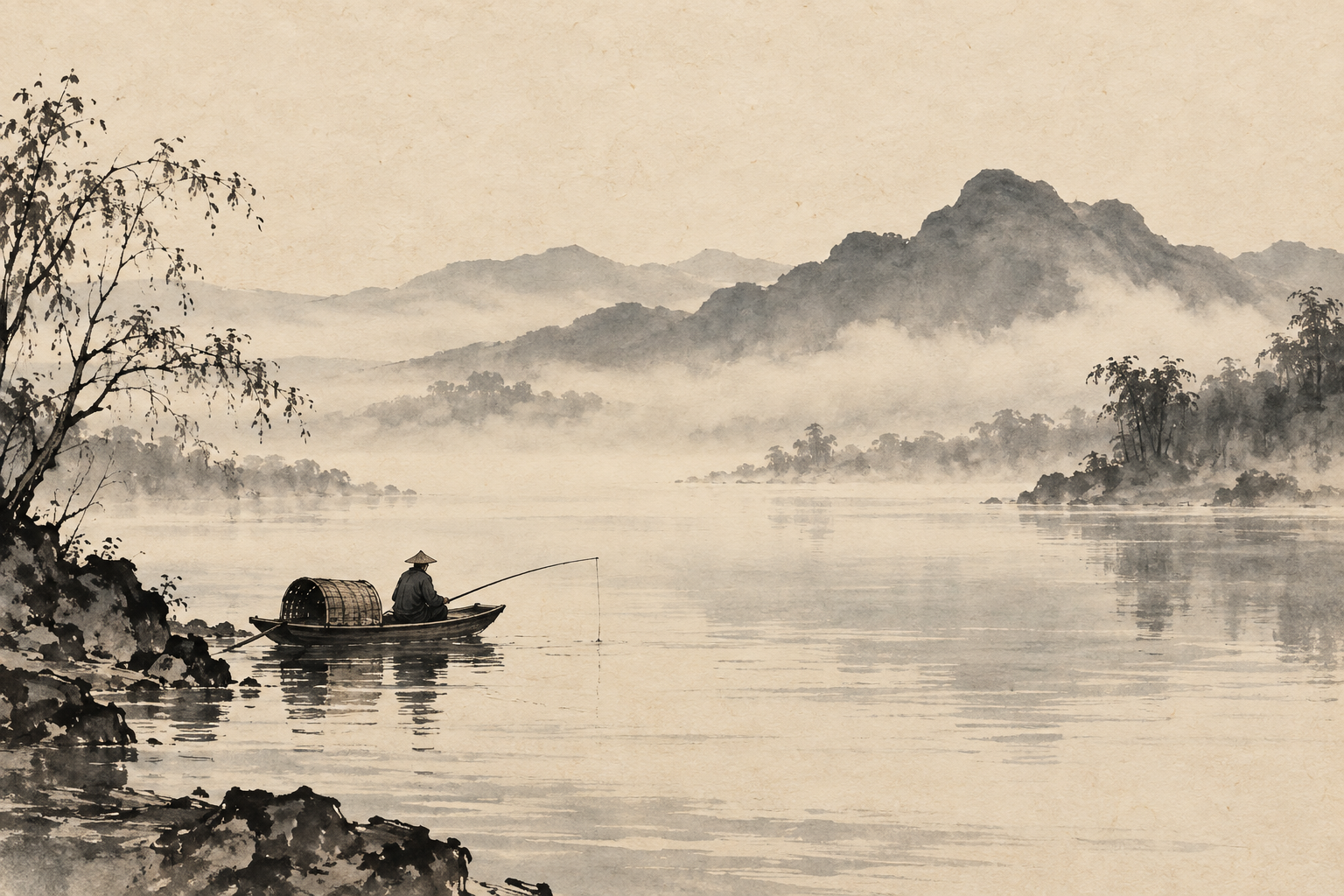
A fisherman can be no larger than a few brush marks, yet that figure may give a broad river its human scale. The lone boatman is also a familiar image of withdrawal from official life in Chinese painting and writing. Look at the person and the space around them together: neither tells the whole story alone.
First, find the boat
Start with the water. Is it an open pale band, a river enclosed by banks, or a stretch of mist? Then find the boat and ask how much of the landscape the figure occupies. A very small boat can make surrounding mountains seem distant and the water expansive. Its position may also guide your eye along the scroll.
The Met's landscape exhibition describes the humble fisherman as a recurring figure in works that imagine a simpler life on the water. Its collection record for Mao Qiling's Lone Fisherman on a Boat directly identifies the solitary angler as a symbol of reclusion in premodern China.
Then ask whose idea of retreat this is
Reclusion is a historical theme, but its meaning changes with the work. The fisherman might stand for an artist, a patron, a literary figure, or an imagined way of life. A title, poem, dedication, or catalogue record can help. Avoid saying every small boat means the same thing. Some boats also serve a narrative or compositional role without being a private self-portrait.
If the image is a long handscroll, view it a section at a time. A boat may appear after crowded banks or before a wide opening. That sequence alters its effect. On a product image, check whether a crop has removed the setting that made the figure legible.
Explore next: How to view a Chinese handscroll and blank space in shanshui.