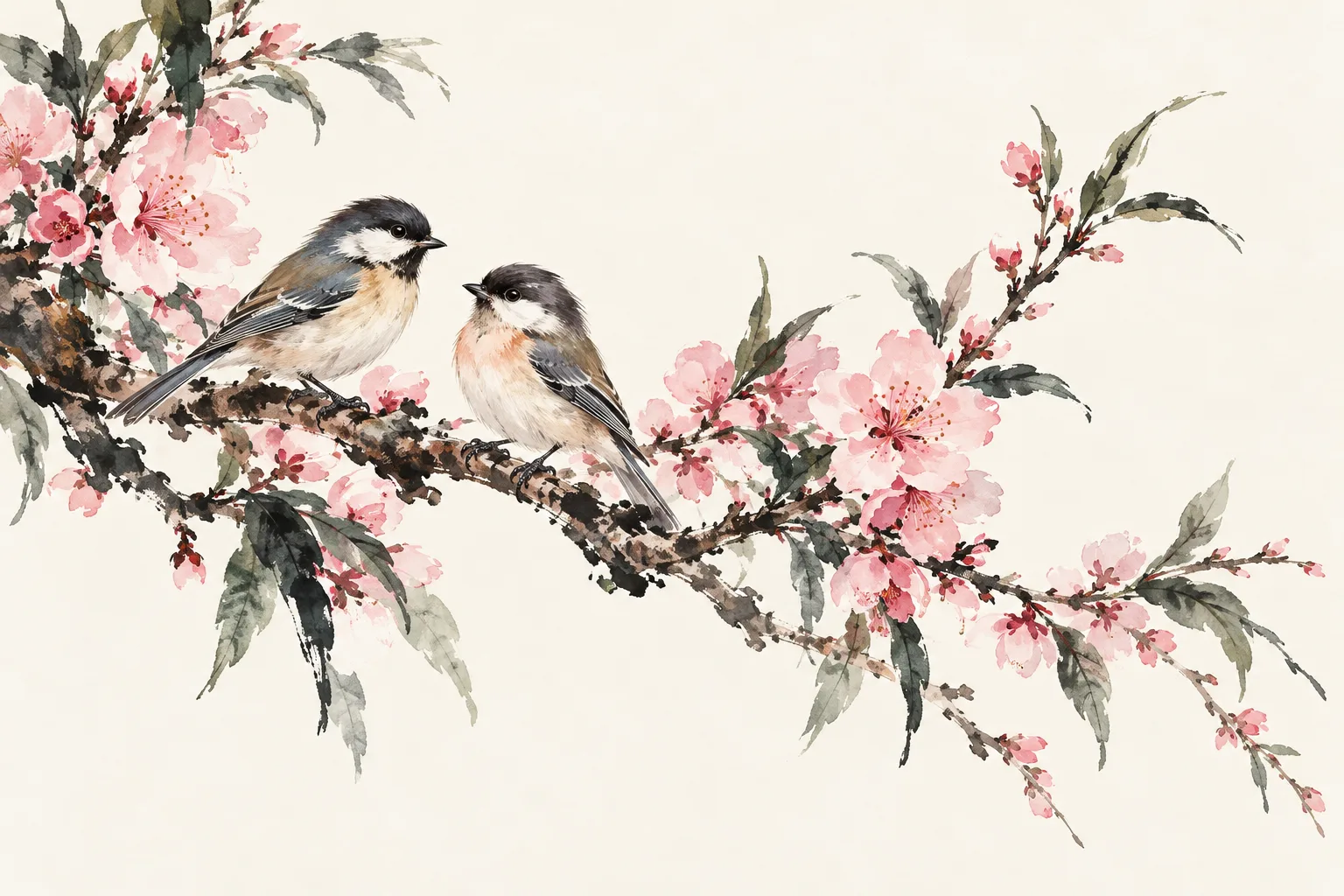
Where should you begin with a bird-and-flower painting?
Begin with the relationship between the living things: where a bird faces, how it holds a branch, and which flowers or leaves surround it. Then look at the differences between fine outlines and broader marks. Identifying a symbolic meaning can come later, when a reliable label or inscription supports it.
The National Palace Museum’s record for Peach Blossoms and Mountain Birds, attributed in its catalogue to Wang Yuan, lists peach blossoms, birds, unusual rocks, bamboo and a stream among its subjects. Even this short inventory suggests how much can belong to a scene beyond the two subjects in the title. National Palace Museum: Peach Blossoms and Mountain Birds.
Follow a bird’s direction
Choose one bird and describe its pose in ordinary words. Is it perched, turning or looking downward? Now follow the direction of its head. Does your eye encounter another bird, a flower, an open interval or the edge of the picture? Treat that route as a looking experiment rather than proof of the painter’s intention.
Next, compare the bird’s body with the branch that carries it. A curved branch and a compact body create different shapes. The gaps around them can be as useful to notice as the objects themselves. Try a quick sketch using only three lines and three small shapes: what becomes essential when you leave out detail?
Compare how different things are painted
Zoom in only after viewing the complete composition. Compare a feather, a petal, a leaf and a rock if all are present. Are their edges equally sharp? Does the same kind of mark recur? If you are viewing a reproduction, remember that resolution, lighting and screen settings limit what you can infer about actual brushwork and color.
Do birds and flowers always carry a coded message?
Do not assume a universal translation from a species to a single meaning. A careful reading names the species only when identification is supported, and distinguishes an inscription or museum interpretation from a personal association. Enjoying a bird’s alert posture does not require solving a hidden message.
Read the attribution as carefully as the image
Museum wording matters. The Smithsonian’s Flowers and birds is dated to the Qing dynasty and described as formerly attributed to Wang Yuan. That is different from a confirmed work by that painter; a historical attribution should not be silently turned into authorship. Smithsonian: Flowers and birds.
Continue with bamboo and rocks or poetry and inscriptions. Both offer ways to connect close looking with the information that accompanies a painting.