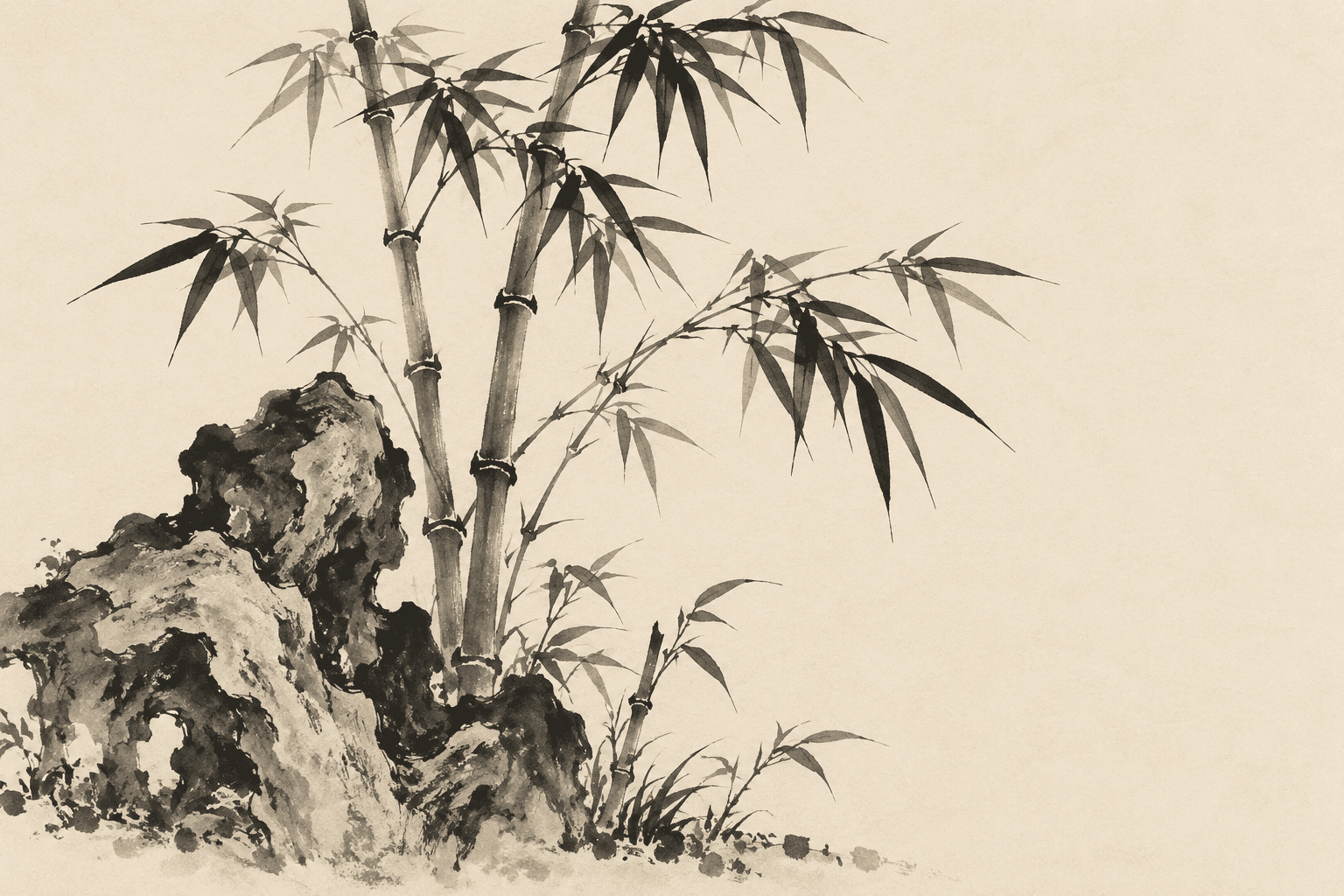
A few bamboo stalks can fill a painting with movement. Their straight sections rise, leaves change direction, and a dark rock gives the eye somewhere to pause. The subject may look simple, but the relationship between marks is carefully balanced.
Zheng Xie’s Bamboo and Rocks, held by the Palace Museum in Beijing, is a useful example. The museum identifies it as a Qing dynasty ink painting on paper by Zheng, measuring 120 by 59.7 centimetres. It describes two slender bamboo stalks, rocks below and several bamboo shoots. The museum also records an inscription by the artist. Palace Museum collection record
Look at the leaves before the symbols
Bamboo is often associated with strength and flexibility. The Smithsonian’s National Museum of Asian Art explains that it has been valued as a motif in Chinese painting for centuries and connects it with the “Four Gentlemen” and the “Three Friends of Winter.” Smithsonian education resource
Those associations can be a useful starting point, but they are not the whole painting. Look at the leaves. Some angle upward; others lean or overlap. A broad brushstroke can suggest a leaf turning toward us, while a narrow one may read as a sharp edge. The plant feels alive through these changes.
Notice the rock’s weight
The rock does not merely fill the lower corner. Its dark, irregular form changes the balance of the long vertical composition. The bamboo’s slender lines feel more flexible beside it. The young shoots at the base introduce another scale and stage of growth.
Try covering the rock with your hand for a moment, then uncover it. How does the painting’s weight change? This simple exercise keeps attention on the visual structure before you reach for an abstract meaning.
Read the inscription with care
Zheng’s inscription is part of the work, not a decorative label added later. The Palace Museum records its wording and notes the artist’s distinctive way of bringing bamboo shoots into the scene. Unless you have a reliable translation for a particular work, avoid turning every bamboo painting into the same proverb. The words, the image and the occasion of the painting can be more specific than a general symbol.
The Metropolitan Museum of Art holds another Zheng Xie work, Orchids and Bamboo, dated 1742. Its collection entry connects bamboo with literati ideals but also explains the painting’s friendship and inscription context. That is a reminder that the same plant can appear in works made for different people and purposes.
What stays with you
You may take bamboo as an image of resilience, or you may simply enjoy the tension between soft leaves and firm rock. Both responses can begin with close looking. Follow the brush, the empty spaces and the directions of the leaves. The painting offers more than one way to stay with it.
Continue exploring: Read HUALI’s Bamboo and Rocks story page, and compare other works in the HUALI collection.