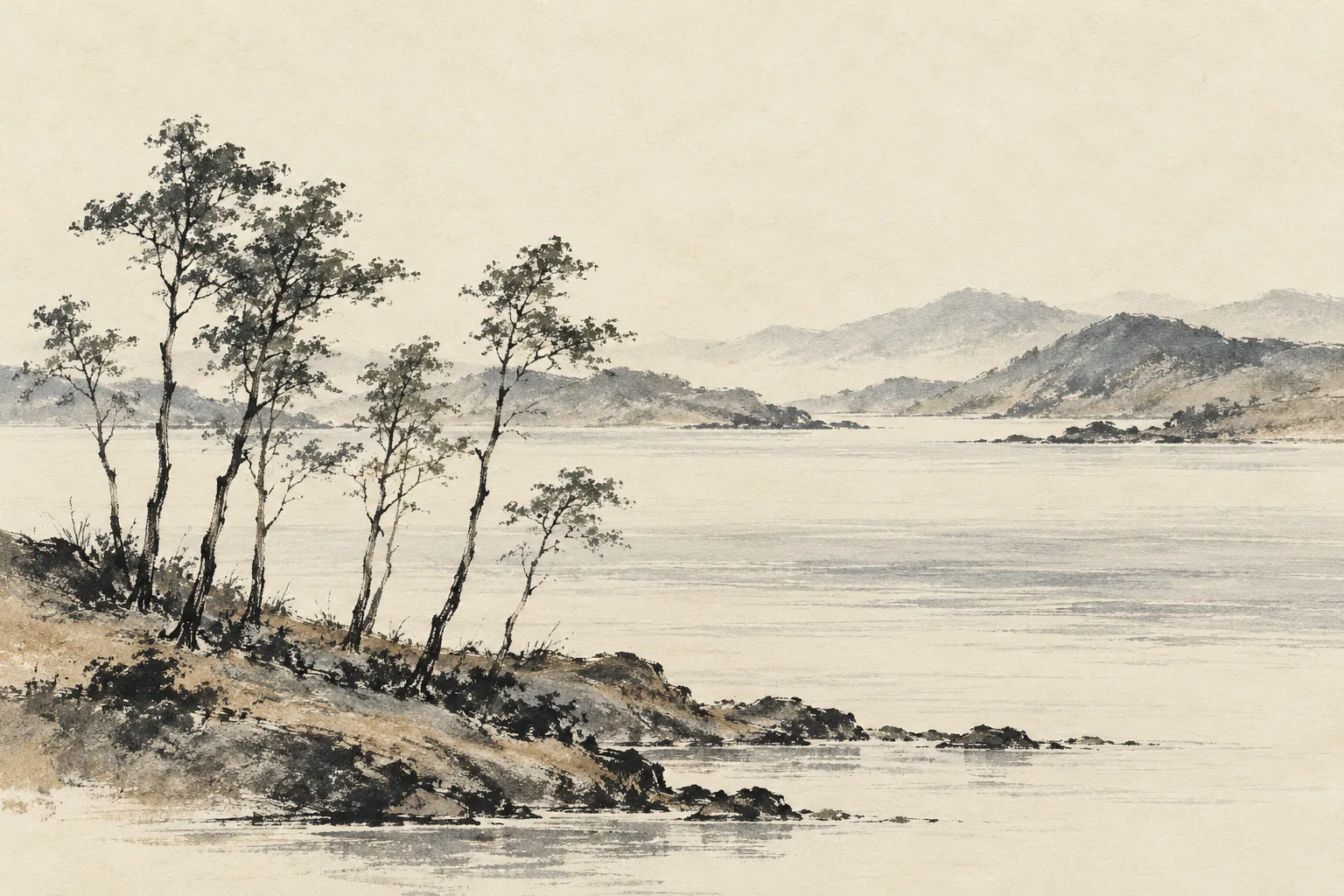
A title can be younger than the painting it names. The National Palace Museum exhibition on Rongxi Studio describes a composition built on a river between two banks, and notes that the title comes from a later inscription mentioning Pan's residence. The picture supplies a landscape; the name arrives through writing added afterwards. Reading a title like this means keeping three things apart: what is depicted, what the added writing says, and what the label actually asserts.
Check the title against the picture before interpreting it
Start by asking whether the title names something you can actually see. In the Rongxi Studio description, the composition is a river separating two shores, so a viewer hunting for a walled studio inside the painted area may come up empty. That gap is worth recording rather than explaining away. Treat the title as a claim with a source, and check whether the label states it: a later inscription, as here, or a descriptive formula such as Landscape in the Style of Ni Zan. Where the label says nothing about where the name comes from, write 'title source not recorded' and leave it.
National Palace Museum: Paintings and Their Museum Labels
Look for the naming writing on the mounting, not only the image
Added writing does not sit only on the painted surface. The Met's essay on Chinese painting notes that later owners and viewers could add inscriptions and seals, that colophons can appear on borders or endpapers, and that some writing is on the image itself; its example, Night-Shining White, grew through later additions. For a title check, that means scanning the mounting as well as the picture. A name may be carried by a colophon on a border, in which case the edge of the work, not its centre, is where your question gets answered.
The Met: Chinese Painting, Maxwell K. Hearn
A three-pass exercise for one title
Fold a page into three columns headed Title words, Visible, and Label says. In the first, write the title exactly as given. In the second, list only elements you can see that the title mentions, and put a dash where nothing matches. In the third, copy the label's own words about the origin of the name, or write 'not stated'.
Keep the columns separate for the whole visit. The exercise works because nothing gets to migrate from one column to another on the strength of a confident-sounding title. If you photograph the label, take a second image of the mounting, since that is where added writing can sit.
When the title names a style rather than a place
Some titles announce a relationship instead of a location. The same exhibition describes Wang Jian's Landscape in the Style of Ni Zan as a reinterpretation, pointing to a slanting tree and a foreground bank. Here the productive question is not where the scene is but which features of the earlier painter the later work takes up. Use the two features the label names as your starting list, add only what you can see, and resist turning one label's pair of features into a rule for every painting by that earlier artist.
National Palace Museum: Paintings and Their Museum Labels
Keep the title's history separate from the attribution line
A name in a title and a name in an attribution line are different kinds of claim. The exhibition identifies Scattered Trees and Distant Mountains as attributed to Ni Zan, with a label suggesting a later copy, and it asks viewers to distinguish current attribution, older attribution and confirmed authorship. The Smithsonian record for a Flowers and birds describes that work as formerly attributed to Wang Yuan, which does not mean confirmed authorship, and it is a separate object from the National Palace Museum's Peach Blossoms and Mountain Birds. Copy the exact phrase the record uses, and do not let a resonant title stand in for an attribution.
National Palace Museum: Paintings and Their Museum Labels · Smithsonian: Flowers and birds
What the title does not settle
The Met's essay cautions that interpretation depends on a particular work and its context, not on a universal dictionary of symbols. A name supplied by a later inscription is evidence about how a painting was named and handed on; it does not decode each building, rock or tree in the picture. Where the label and the writing stop, mark the rest as your own reading, and say so in your notes.
The Met: Chinese Painting, Maxwell K. Hearn
Questions readers ask
Is a title taken from a later inscription unreliable?
It is later, not automatically unreliable. It records how the work was named and passed on, and it does not by itself confirm who painted it.
Can the title tell me what the scene shows?
Only where the label connects the two. In the Rongxi Studio case the exhibition ties the name to an inscription mentioning Pan's residence; without such a link, describe what is in front of you and leave the identification open.
Does 'in the style of' mean the work is a copy?
The exhibition calls Wang Jian's painting a reinterpretation of Ni Zan, so read the label's wording and look for the features it names before deciding what kind of relationship is being described.
Sources
The Met: Chinese Painting, Maxwell K. Hearn — source notes checked 2026-10-20.
National Palace Museum: Paintings and Their Museum Labels — source notes checked 2026-10-20.
Smithsonian: Flowers and birds — source notes checked 2026-10-20.