Attribution wording tells you how a museum currently connects a work to an artist’s name. Read the exact phrase alongside the date, material and explanation. The examples below show why an older attribution should not be repeated as confirmed authorship. These phrases are not a standardized numerical confidence scale, and an unidentified current artist can coexist with a recorded historical attribution.
Four phrases, four different claims
Start by distinguishing a current attribution from a former one. A name qualified by attributed to should retain that qualification in your notes. Formerly attributed records an earlier association, while a traditional attribution can preserve a historical name without establishing the maker. Read the institution’s explanation rather than assigning a universal confidence score to each phrase.
The National Palace Museum exhibition makes this visible in one room: it identifies Scattered Trees and Distant Mountains as attributed to Ni Zan, and its label goes further, suggesting a later copy. The Smithsonian record for a Flowers and birds uses a different formula, formerly attributed to Wang Yuan, and dates the work 1644 to 1912, Qing dynasty, ink and color on silk. That wording does not mean confirmed authorship.
A practical habit: copy the exact phrase into your notes rather than shortening it to by. That shortening can turn a qualified attribution into a stronger claim.
National Palace Museum: Paintings and Their Museum Labels · Smithsonian: Flowers and birds
Read the rest of the label before the name
The name is one field among several that can help you distinguish objects. A museum record for Pavilion on a pond currently gives Unidentified artist, dates the work to the sixteenth or seventeenth century, describes it as a fan mounted as an album leaf in ink and color on silk, and notes a traditional attribution to Li Song. Four separate statements, each with its own weight.
Try this with an online record: note the date range, support and format before copying the artist heading. Then add any qualification attached to the name. This separates the catalogue’s different statements without assuming that one field is more reliable than another.
In the style of names the model, not the maker
Some titles contain a painter's name without making any claim about who held the brush. Wang Jian's Landscape in the Style of Ni Zan, as the exhibition describes it, is a reinterpretation, with a slanting tree and a foreground bank. The name in the title announces a stylistic reference the later painter chose to make, not a disputed authorship.
When a name appears in a title, ask whether it refers to the maker or to an earlier artist being referenced. A useful annotation in your notes is painter here, reference there. Keep the title and artist heading in separate fields.
National Palace Museum: Paintings and Their Museum Labels
Compare two labels side by side
Side-by-side reading can help you compare specific catalogue fields. One National Palace Museum entry names Wang Yuan and lists peach blossoms, birds, unusual rocks, a stream and bamboo, with paper as the support. A Smithsonian Flowers and birds is a different work, formerly attributed to Wang Yuan, dated to the Qing dynasty, ink and color on silk. The names overlap; the objects, dates and supports do not.
Draw three columns on a page: heading, date, support. Fill them from each record, then mark which cells are firm and which are softened by wording such as attributed or formerly. What emerges is not one verdict but a bundle of separate claims that happen to sit on the same card. Never merge two records because a surname matches.
National Palace Museum: Peach Blossoms and Mountain Birds · Smithsonian: Flowers and birds
What the label will not tell you
A concise catalogue entry may leave interpretive questions open. Interpretations depend on a particular work and its context, not on a universal dictionary of symbols, and a catalogue entry that lists peach blossoms and birds does not establish what any species signifies. Writing on a painting raises a parallel caution: later owners and viewers could add inscriptions and seals, on the image itself or on colophons at borders and endpapers, so text on a surface is not automatically the painter speaking.
A three-line exercise helps separate the layers. Line one: what the label states. Line two: what you can actually see, described without interpretation. Line three: what you think or feel. Keep them apart on the page and you will notice immediately when a personal response has quietly been promoted into a fact about the object.
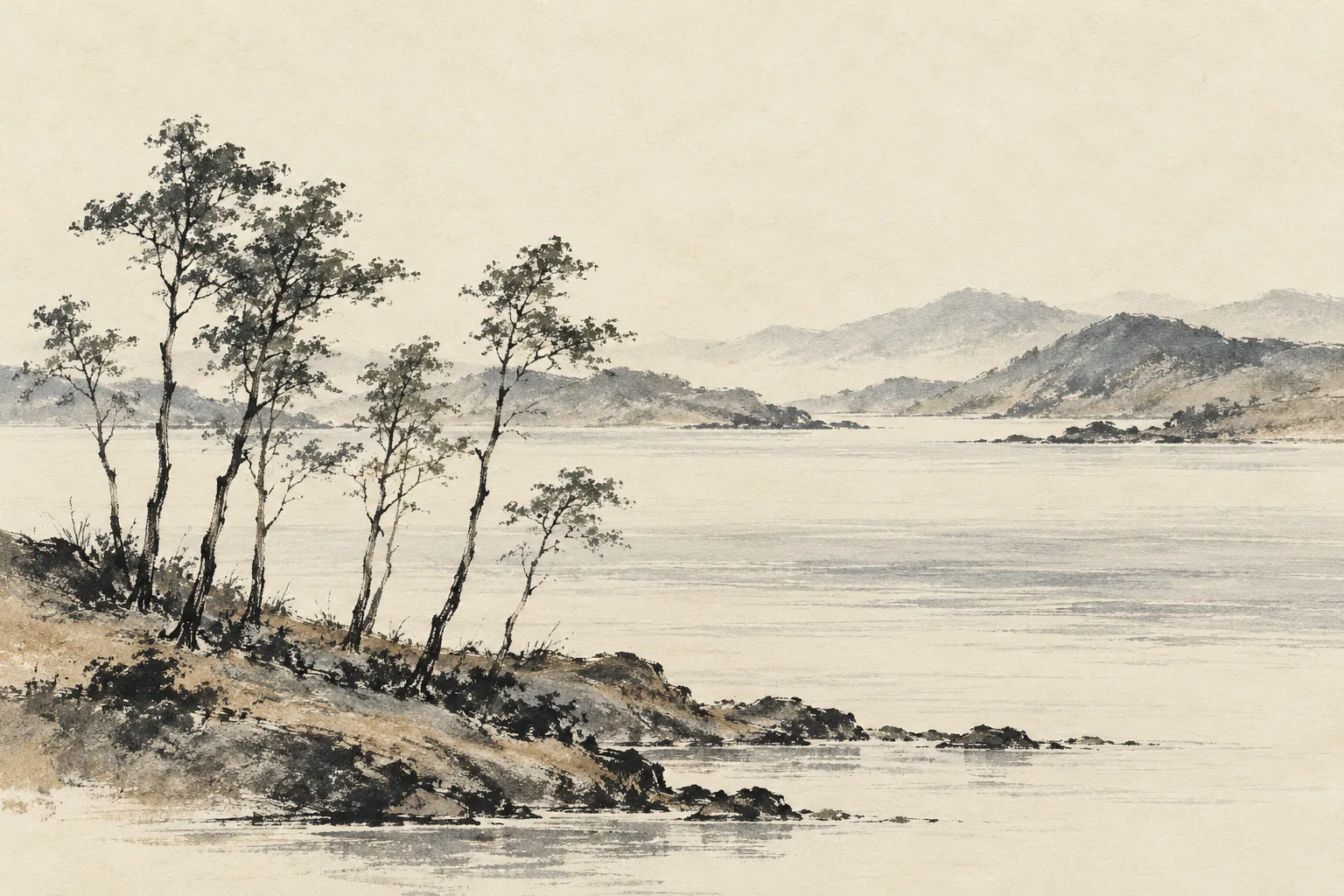
For the illustrations that accompany articles in this journal, assume the drawing is thematic. It is made to support the reading habit, not to reproduce the museum object under discussion.
The Met: Chinese Painting, Maxwell K. Hearn · National Palace Museum: Peach Blossoms and Mountain Birds
Questions readers ask
Is an attributed painting a fake?
No. The phrase marks uncertainty about authorship, not fraud. A work can be of its stated period and still worth close looking while the name remains open.
Does formerly attributed mean the museum now rejects the work entirely?
It means the earlier name is no longer the current heading. The new heading may be a different painter, a workshop, or unidentified artist, so read that field too.
Do I need to care about attribution if I simply like the picture?
Not for pleasure. It matters when you compare works, follow a period style, or repeat a claim about who painted something.
Sources
The Met: Chinese Painting, Maxwell K. Hearn — source notes checked 2026-10-20.
National Palace Museum: Paintings and Their Museum Labels — source notes checked 2026-10-20.
The Met: Pavilion on a pond — source notes checked 2026-10-20.
National Palace Museum: Peach Blossoms and Mountain Birds — source notes checked 2026-10-20.
Smithsonian: Flowers and birds — source notes checked 2026-10-20.