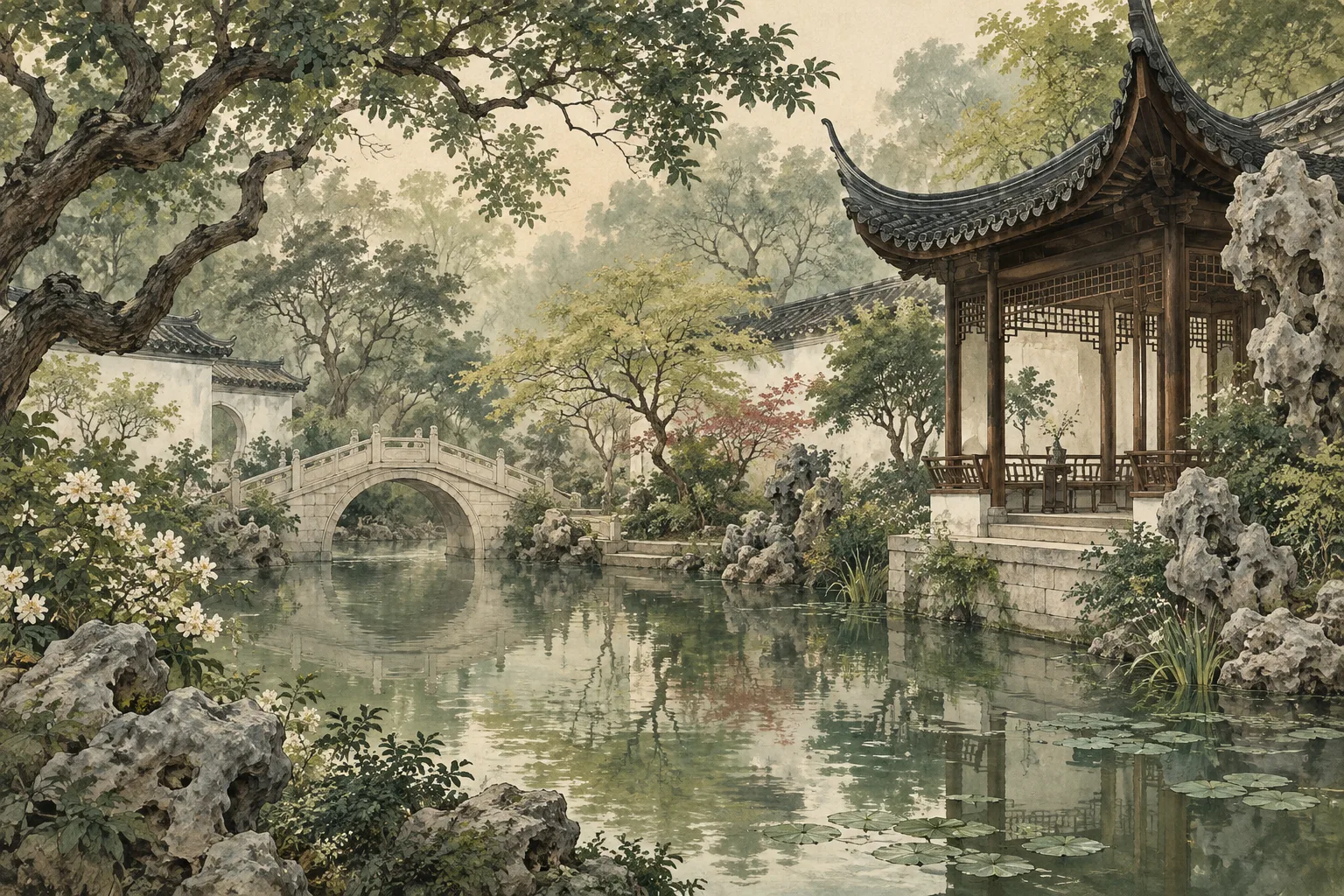
Not automatically. A garden scene establishes that garden imagery was a subject worth painting; on its own it does not identify a plot of ground, a patron or a planting plan. What you can check is what the label actually asserts — a named estate, a poem, a date, an attribution — and then keep your description of the picture separate from those assertions.
Separate the scene from the claim in front of it
A garden picture is evidence for garden imagery before it is evidence for a garden. The Met's exhibition on Chinese gardens treats garden imagery as a subject running across painting and other media, which means the imagery has a life of its own beyond any single site. Read the label in two passes: first the visual description you can verify yourself — water, rockwork, a bridge, buildings — and then the label's claims about place, owner, poem or date. Where the label names no garden, describe garden imagery and stop there.
Three built cues that suggest designed ground
On the Met's fan mounted as an album leaf, dated to the sixteenth or seventeenth century and painted in ink and color on silk, the record points to elaborate rocks, a low stone bridge and buildings across water as signals of a designed garden. Use these as a checklist rather than a formula: rockwork that looks placed rather than found, a bridge joining two banks, buildings standing across water from the near edge. Then ask what the picture leaves out.
The same record lists the current heading as Unidentified artist, with a traditional attribution to Li Song noted alongside. That line concerns authorship, and it does not settle whether a garden stood anywhere.
Poetry moves in both directions
The traffic between gardens and images runs both ways. Famous gardens commemorated in painting and poetry could inspire later garden designers, and Wang Wei's poems about his country estate are described as inspiration for handscrolls. A picture may therefore stand downstream of a poem about a place, or upstream of a garden made later; the label, not the picture, indicates which claim is on offer.
When a label names a poet or a poem, write that down separately from your visual description, then ask whether the work is said to illustrate the text or only to share its subject. If the label is silent, leave the question open.
What the picture cannot settle
A building in a painting is not evidence of where the painter lived, and a painted rock is not evidence of a rock. Both moves run past what a garden record supports. The same caution applies to meaning: interpretation depends on the particular work and its context rather than on a dictionary of symbols applied from outside. If you want to say what a blossom or a stone signifies in this picture, the support has to come from this label and this image.
The Met: Chinese Painting, Maxwell K. Hearn
A comparison exercise you can run in ten minutes
Choose two garden scenes, side by side or in the same catalogue, and answer four questions for each in two columns: which built elements can I point to; where does water sit relative to the viewer; what does the label claim about place, poem or owner; where does the label hedge — unidentified, attributed, in the style of? Finish by writing one sentence each picture supports and one it does not. The aim is not to recover the real garden but to keep your eye and the label's claim from merging.
Questions readers ask
Does a garden scene show a specific historical garden?
Only if the label or an inscription says so. Without that, it is garden imagery: a designed-looking space, not a survey of a site.
Can I name the plants in a garden painting from the picture alone?
Treat that cautiously. A catalogue entry may list blossoms without naming a species, and a planting plan is a different kind of claim from a painted branch.
Why does the heading say Unidentified artist when the record names someone?
A record can carry a traditional attribution alongside a current heading of Unidentified artist. The older name is a survival, not confirmed authorship.
Sources
The Met: Chinese Painting, Maxwell K. Hearn — source notes checked 2026-10-20.
The Met: Chinese Gardens — source notes checked 2026-10-20.
The Met: Pavilion on a pond — source notes checked 2026-10-20.