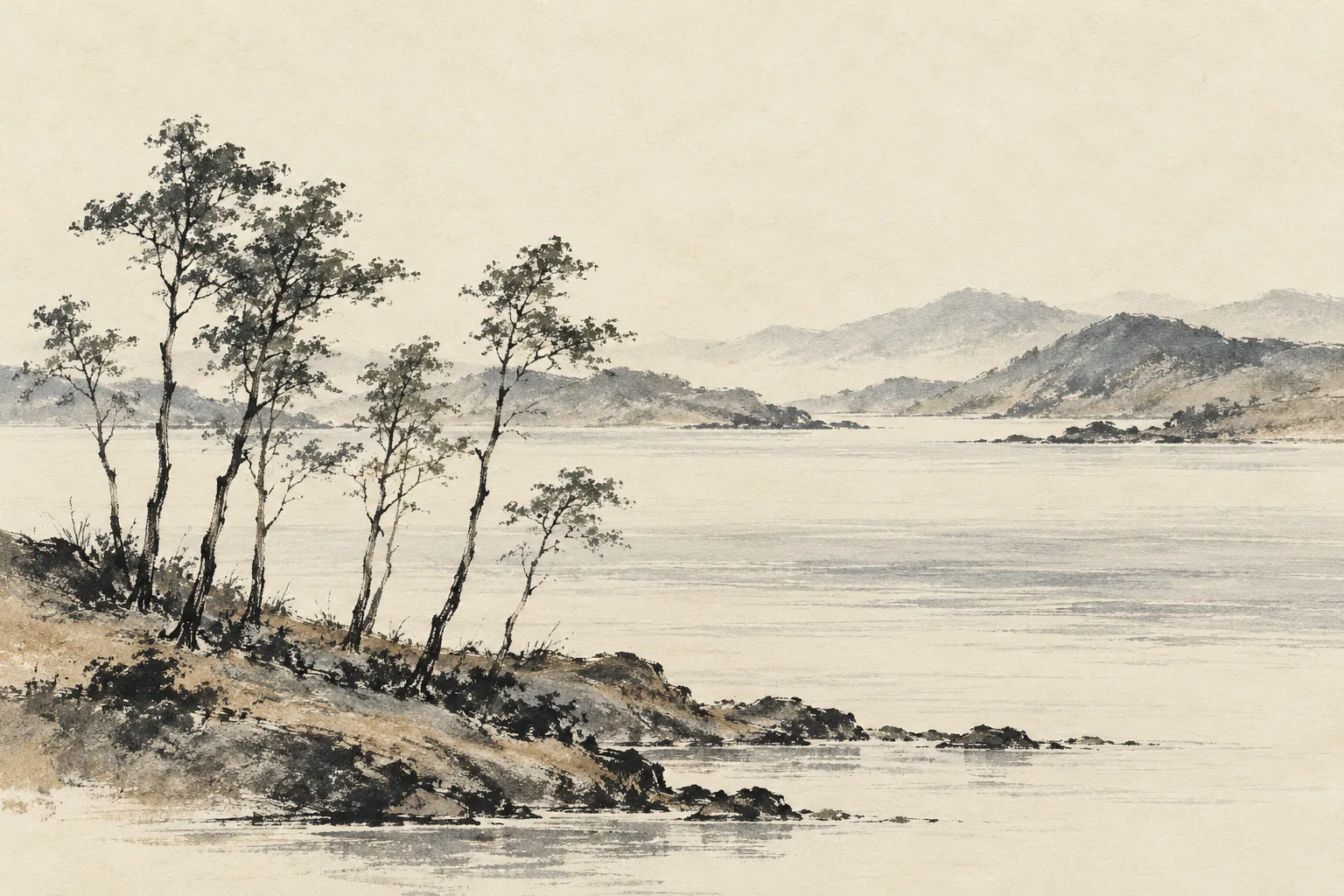
A label that says in the style of means the painting is by a later artist working in an earlier painter's manner, not that the earlier painter made it. The practical task is to separate that relationship from neighboring label phrases such as attributed to and formerly attributed, then compare the visual features the label actually names.
Read the phrase before the name
Labels put several kinds of statement close together, and they are easy to blur. A work may be called Landscape in the Style of Ni Zan; another record may name Ni Zan as the artist; a third may say attributed to Ni Zan. The National Palace Museum exhibition uses the first wording for Wang Jian's reinterpretation, while it identifies Scattered Trees and Distant Mountains as attributed to Ni Zan and notes a label suggesting a later copy (npm-labels). Those are different claims: a later painter's reinterpretation, a traditional ascription and a suggested copy should not be collapsed into one.
The Smithsonian record for a Flowers and birds adds another wording: formerly attributed to Wang Yuan, dated 1644–1912, ink and color on silk. That is a changed cataloguing position, not confirmed authorship, and it concerns a different object from the National Palace Museum's Peach Blossoms and Mountain Birds (si-attribution). Attribution labels are not a standardized numerical confidence scale, and Unidentified artist does not prove that no historical attribution survives. Copy the exact wording before interpreting it.
National Palace Museum: Paintings and Their Museum Labels · Smithsonian: Flowers and birds
Compare structure, not atmosphere
The useful comparison is structural. The exhibition describes Rongxi Studio as using a river between two banks, with its title coming from a later inscription that mentions Pan's residence. It describes Wang Jian's Landscape in the Style of Ni Zan as a reinterpretation with a slanting tree and a foreground bank (npm-labels). Those details give you something to look for: the width of the water, the amount of shore in the foreground, and the angle at which a tree crosses the interval.
Try a three-column exercise. In the first column, mark river and banks. In the second, mark trees and their directions. In the third, write only what the label says the later painter changed. The aim is to see what was selected for reuse, not to decide which painting is better. If the label gives no visual cues, leave the columns sparse rather than filling them with guesses.
National Palace Museum: Paintings and Their Museum Labels
What the phrase does not tell you
The phrase does not explain motive or the museum's final view of authorship. It also does not turn a painting into a symbol puzzle. The Met essay notes that later owners and viewers could add inscriptions and seals, and that interpretation depends on a particular work and context rather than a universal symbol dictionary (met-reading). A style label is local in the same way: it describes a relationship between works, not a key that unlocks every motif.
Nor is it a forgery verdict. Wording such as later copy or attributed to makes a category statement; it is not an authentication ruling. If a label suggests a later copy, record that as the label's suggestion, not as a confirmed fact (npm-labels).
The Met: Chinese Painting, Maxwell K. Hearn · National Palace Museum: Paintings and Their Museum Labels
A viewing routine you can use at the label
A short routine keeps the claim visible. First, copy the full artist line and the phrase in the style of exactly. Second, circle the named model and note separately who is credited with making the object. Third, find one or two cues the label mentions and mark whether they are stated or only implied. Fourth, compare a nearby label that uses attributed to or formerly attributed, so the difference in wording stays concrete. Fifth, write one sentence about what you cannot tell from the label.
At home, use the same columns on a catalogue page or collection record. A useful note reads: later painter, model named, two described cues, one uncertainty. That is more defensible than a confident style identification.
Questions readers ask
Is in the style of the same as attributed to?
No. In the style of names a later painter working in another artist's manner. Attributed to describes a traditional ascription to the named artist. The exact wording on the label is the difference.
Does in the style of mean the work is a copy?
Not necessarily. The exhibition calls Wang Jian's painting a reinterpretation. A separate label may suggest a later copy; treat that as a distinct statement.
Can style alone identify the earlier artist?
Not reliably. Use the named model and the features the label describes, then compare. Style cues can guide looking but do not replace cataloguing evidence.
Sources
The Met: Chinese Painting, Maxwell K. Hearn — source notes checked 2026-10-20.
National Palace Museum: Paintings and Their Museum Labels — source notes checked 2026-10-20.
Smithsonian: Flowers and birds — source notes checked 2026-10-20.