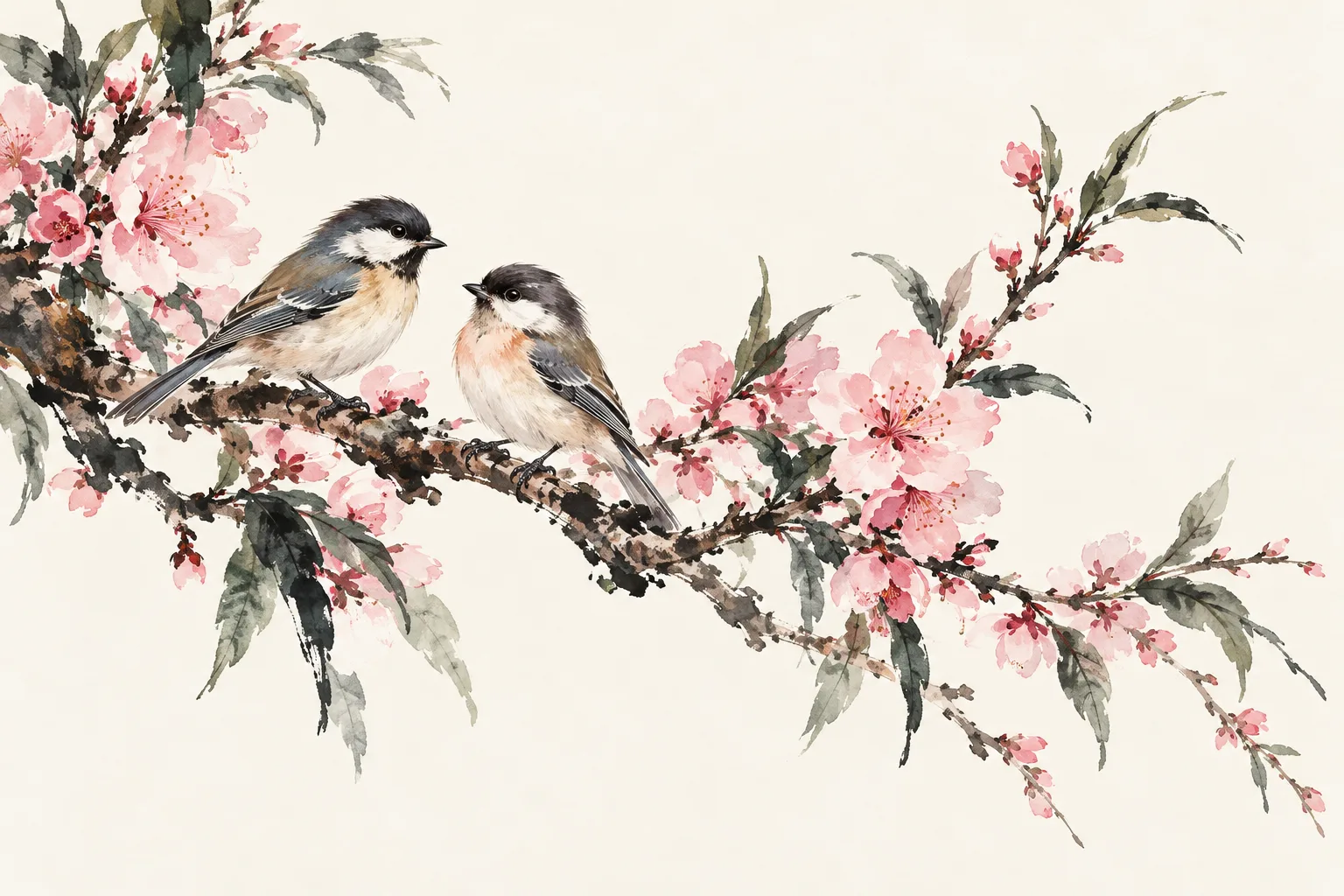
Because a subject list is a description, not an interpretation. A catalogue entry can tell you that a painting shows peach blossoms, birds, bamboo and unusual rocks on paper and still say nothing about what any of them meant. Where meaning can be argued at all, it has to come from the particular work, its texts and its setting, not from a key that assigns one message to each plant.
Read the subject list as an inventory
The National Palace Museum entry for Peach Blossoms and Mountain Birds names Wang Yuan and lists peach blossoms, birds, unusual rocks, a stream and bamboo among the subjects, and it identifies paper as the support. Nothing in that entry assigns a meaning to any of them. These are the things a catalogue can state with some confidence: what is depicted, who is named, what the painting is made on.
So use the list as a checklist before you interpret. If the label mentions a stream and bamboo, find them. If you cannot, that is a looking problem to solve first, and it may tell you something about scale or cropping. The illustration accompanying this article is thematic; it is not the National Palace Museum painting and cannot stand in for it.
National Palace Museum: Peach Blossoms and Mountain Birds
A motif is not a dictionary entry
The Met essay on Chinese painting makes the point directly: interpretations depend on a particular work and its context rather than on a universal symbol dictionary, and its own contrasts should not be generalized to all Chinese painting. A sentence beginning 'in Chinese painting, the peach stands for...' has skipped the step that matters.
A more workable question is narrower: what is this painting doing with these subjects, on this support, in this format? That question can be answered from the object and its record. The dictionary version cannot, because it never looks at either.
The Met: Chinese Painting, Maxwell K. Hearn
Find the writing that anchors a reading
The same Met essay notes that later owners and viewers could add inscriptions and seals, that colophons can sit on borders or endpapers while some writing is on the image itself, and that a single work such as Night-Shining White grew through later additions. A text attached to a painting is therefore part of its history of reception, which is not the same as the artist's starting intention.
This gives you a useful test for any meaning claim. If the claim rests on an inscription, ask when the inscription was added and by whom, as far as the label says. If the label is silent, keep the reading as a proposal and mark it as one in your notes. That is more honest than presenting a guess as catalogue fact.
The Met: Chinese Painting, Maxwell K. Hearn
Keep two records, and two kinds of attribution, apart
The Smithsonian record for a Flowers and birds is catalogued as formerly attributed to Wang Yuan, dated 1644 to 1912 in the Qing dynasty, ink and color on silk. It is a different work from the National Palace Museum painting, with a different date and a different support. 'Formerly attributed' does not mean confirmed authorship, and a reading built for one object should not be carried across to the other because the titles sound alike.
The same caution applies to a heading that reads Unidentified artist: it does not prove that no historical attribution survives. An older name can persist in the record while the current heading stays cautious, so quote the wording you actually see. Before interpreting, write down the title, support, date and attribution phrase exactly as given.
Smithsonian: Flowers and birds · National Palace Museum: Peach Blossoms and Mountain Birds
A short exercise with one label
This is a looking routine, not a claim about any specific painting. Copy the label's subject words in the order they appear. Find each one in the image and note whether it sits at the centre, the edge or somewhere hard to see. Then list what the label leaves out, such as colour, season or time of day, and check whether you can actually see those things.
Finish with two sentences: one you can defend from the label alone, and one you can defend from looking alone. Keep them separate on the page. If a meaning occurs to you, write it as a question first and see whether anything in the record answers it. When nothing does, you have learned something useful about the limits of the evidence.
Questions readers ask
Does a peach blossom always mean long life?
Not on the evidence of a catalogue entry. The checked records here list subjects without assigning meanings, so treat any fixed equivalence as a claim to test against the specific work and its texts.
If the label just says 'Flowers and birds', is the subject unimportant?
No. It is a description at a general level. Use it to organise your looking, then note which plants, birds and rocks you can actually distinguish.
Can a later poem explain an earlier painting?
It can show how later viewers understood the work. That is reception history, and it is worth separating from a claim about what the painter intended.
Sources
The Met: Chinese Painting, Maxwell K. Hearn — source notes checked 2026-10-20.
National Palace Museum: Peach Blossoms and Mountain Birds — source notes checked 2026-10-20.
Smithsonian: Flowers and birds — source notes checked 2026-10-20.