The phrase describes the object. 'Fan mounted as an album leaf' means a painted fan leaf now kept as a page in an album: a statement about present format, made alongside separate statements about date, support and artist. On the collection record summarised here, that mount line sits next to a current heading of Unidentified artist and a note of a traditional attribution to Li Song, which makes the record a compact case in reading a label in layers.
The Mount Line and the Artist Line Are Separate Claims
A collection record is not one sentence but several, and they do not carry equal weight. The mount phrase belongs to physical description: a fan leaf, now an album page. The artist heading belongs to authorship. The date phrase, sixteenth or seventeenth century, belongs to chronology. The support, ink and color on silk, belongs to materials. Read them as four claims instead of one, and apparent contradictions in the record resolve into statements with different backing.
A practical suggestion: copy the record in strips. Put the mount, the support, the date and the name on separate lines of your notes, then mark which lines the museum hedges and which it states flatly. Hedging tends to cluster where the evidence is thinner, and that pattern is worth noting on its own.
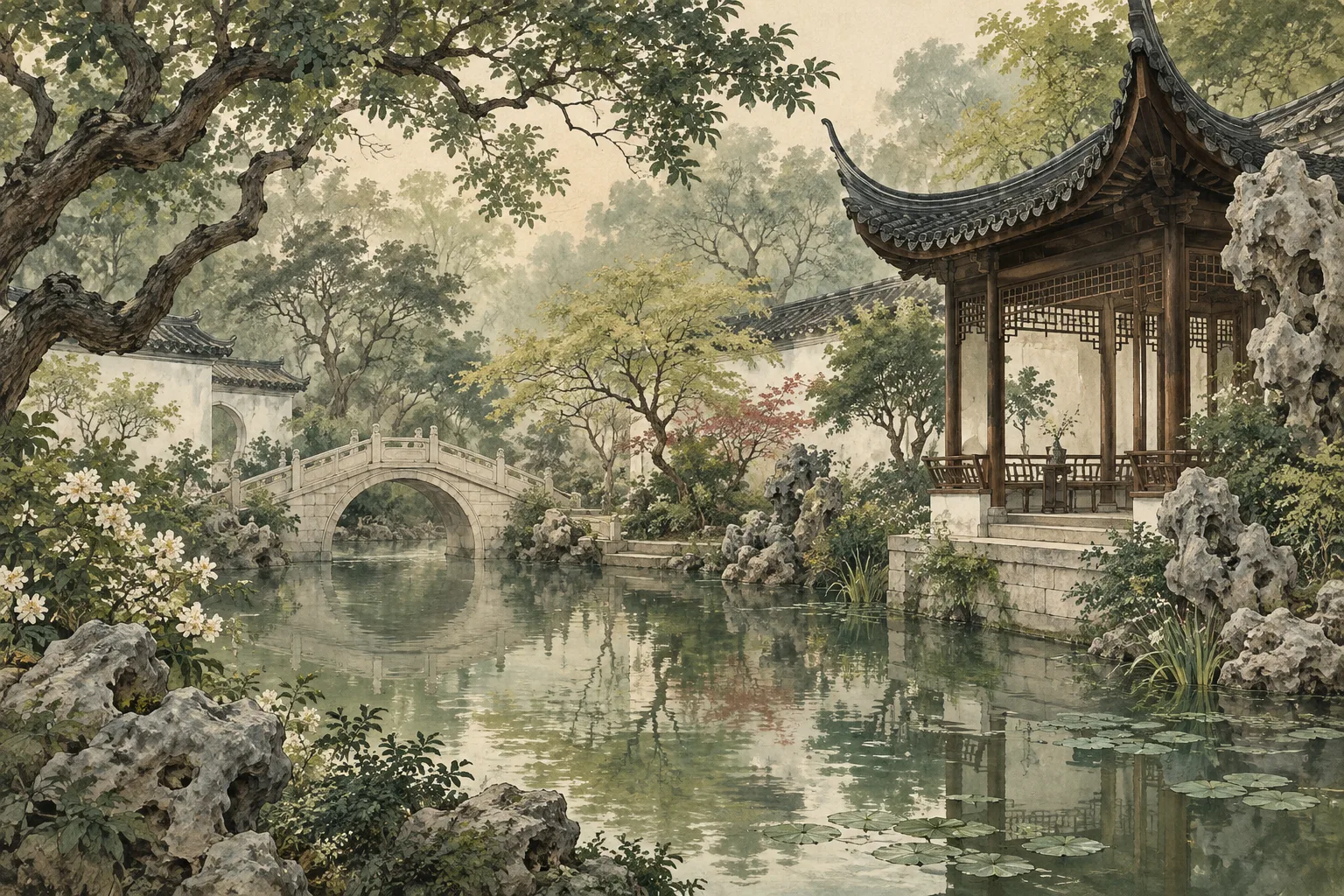
The illustration accompanying this article is thematic, drawn for HUALI. It is not a reproduction of the museum's fan leaf.
Unidentified Artist Does Not Erase Older Attributions
This fan leaf is catalogued under Unidentified artist while the record also notes a traditional attribution to Li Song. Both belong in your notes. Attribution labels are not a standardised numerical scale, so 'traditional attribution' and 'current heading' are not two readings of the same measurement; they are different kinds of claim. Nor does Unidentified artist prove that no historical attribution survives, since here one survives beside it.
The National Palace Museum's exhibition labels draw a comparable set of lines. Current attribution, older attribution and confirmed authorship are distinguished; Scattered Trees and Distant Mountains is presented as attributed to Ni Zan, with a label suggesting a later copy; Wang Jian's Landscape in the Style of Ni Zan is described as a reinterpretation.
Suggested wording for your own notes: current heading, other names on the record, and the basis given, if any. 'Traditionally attributed to Li Song; current heading Unidentified artist' is accurate. 'By Li Song' is not supported by the record as summarised.
The Met: Pavilion on a pond · National Palace Museum: Paintings and Their Museum Labels
What the Picture Description Can and Cannot Carry
The same record describes elaborate rocks, a low stone bridge and buildings across water, and reads these as signals of a designed garden. That is a claim about depicted features, and it deserves to be kept apart from authorship and date. A wider point from the garden exhibition applies here: garden imagery appears across painting and other media, and a painted garden should not be treated as a literal map.
For a gallery visit, ask three questions in order: what is shown, what the label claims about who made it, what the label claims about when. If the answer to the second is thin, the first and third can still stand on their own. Do not infer an artist's life from a building in the picture.
The Met: Pavilion on a pond · The Met: Chinese Gardens
A Comparison Exercise You Can Run From Labels Alone
Set the fan record beside a label for a different garden subject and compare only the wording. The Ni Zan Rongxi Studio label describes a river between two banks; the fan record describes buildings across water. Note how each label uses water to organise the scene, and which features each one mentions. Silence in a label is not evidence of absence in the painting.
Second pass: compare the hedges. One record says 'traditional attribution'; another says a label suggests a later copy. Rank the two statements by how firmly the museum commits, then check whether the physical description in each record sounds equally firm.
Keep in mind that this exercise compares descriptions, not artworks. If you have not seen the objects, record that fact in your notes. A comparison of label language is useful, but it is a different sort of evidence from a comparison of surfaces.
National Palace Museum: Paintings and Their Museum Labels · The Met: Pavilion on a pond
Questions readers ask
Does 'fan mounted as an album leaf' mean the fan was painted for that album?
Not necessarily. The phrase describes the present mount. The record summarised here gives no separate date for the mounting, so treat the album as a container and leave the question of original purpose open.
Is it wrong to call this fan leaf a work by Li Song?
As a statement of confirmed authorship, yes. The record keeps a traditional attribution to Li Song under a current heading of Unidentified artist. Name both when you describe it.
Can I use the label's date range for the mounting as well?
No. The date belongs to the work as catalogued, and the mount is described on its own terms. Nothing in the record as summarised here dates the album page itself.
Sources
National Palace Museum: Paintings and Their Museum Labels — source notes checked 2026-10-20.
The Met: Chinese Gardens — source notes checked 2026-10-20.
The Met: Pavilion on a pond — source notes checked 2026-10-20.