Short answer: read the date as the span the catalogue assigns to the object, and keep it in the record's own wording. Two entries in the sources show how different those spans can look. A fan mounted as an album leaf is dated to the sixteenth or seventeenth century in a record whose current heading is Unidentified artist, while a Flowers and birds is dated 1644–1912, Qing dynasty, and formerly attributed to Wang Yuan. Neither is a single year, and neither settles who painted the work.
Two forms of date phrase, one field
In the Met record, the date is a century span, given beside the format (a fan mounted as an album leaf) and the medium (ink and color on silk) [met-pavilion]. In the Smithsonian record, the date is a dynasty name with years, 1644–1912, beside a different medium line, also ink and color on silk [si-attribution]. Same field, different wording.
So copy the phrase word for word, including the word dated and any dynasty name, and resist turning sixteenth or seventeenth century into 1600s. If you compare two works later, you want to compare the catalogued phrases, not your paraphrase of them.
The Met: Pavilion on a pond · Smithsonian: Flowers and birds
The date line and the artist line are separate statements
The Met entry keeps Unidentified artist as the current heading while the same record notes a traditional attribution to Li Song [met-pavilion]. The Smithsonian entry reads formerly attributed to Wang Yuan [si-attribution]. The National Palace Museum exhibition material draws the distinction plainly: current attribution, older attribution and confirmed authorship are three different things, and its label for Scattered Trees and Distant Mountains suggests a later copy while the work stays under an attributed heading [npm-labels].
Reading habit: say them as two sentences. The record dates this work to the sixteenth or seventeenth century. The record lists the artist as unidentified and notes a traditional attribution to Li Song. Neither sentence borrows authority from the other.
The Met: Pavilion on a pond · Smithsonian: Flowers and birds · National Palace Museum: Paintings and Their Museum Labels
A worked comparison: two bird-and-flower records
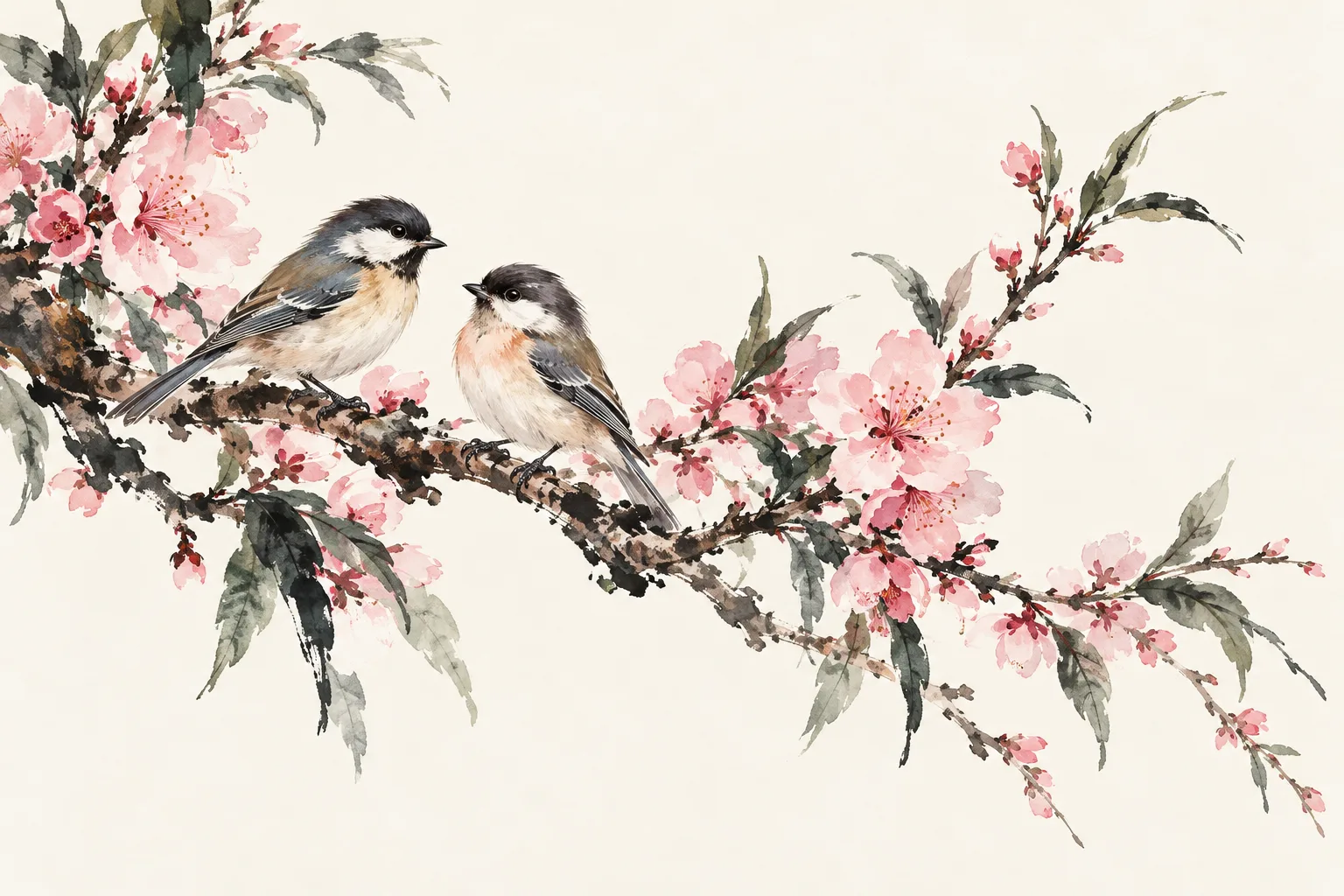
The National Palace Museum entry names Wang Yuan and lists peach blossoms, birds, unusual rocks, a stream and bamboo, with paper as the support [npm-birds]. The Smithsonian entry is a Flowers and birds formerly attributed to Wang Yuan, dated 1644–1912, ink and color on silk [si-attribution]. These are different works, and the sources warn against merging their objects, dates or supports; a paper support and a silk support do not describe one object.
Method: four lines for each record — attribution phrase, date phrase, support and format, collection. Set them side by side before deciding that two similar titles describe one painting. On this pair, three of the four lines disagree.
National Palace Museum: Peach Blossoms and Mountain Birds · Smithsonian: Flowers and birds
What the date phrase does not settle
It does not name pigments or bird species. The National Palace Museum entry lists its subjects without assigning them fixed meanings, and catalogue facts of that kind do not establish a universal symbolic meaning for a species [npm-birds].
It also does not date everything written on or around the work. Later owners and viewers could add inscriptions and seals; colophons can sit on borders or endpapers while some writing is on the image itself, and Night-Shining White grew through later additions [met-reading]. A sixteenth-or-seventeenth-century date for a painting and the date of an inscription on it are two questions, and dating the writing from the painting's label merges them.
National Palace Museum: Peach Blossoms and Mountain Birds · The Met: Chinese Painting, Maxwell K. Hearn
A note-taking exercise for the gallery
Suggestion only, not a method the cited museums prescribe. Take three labels in one gallery and give each a four-line card: artist phrase as printed, date phrase as printed, support and format, then one line of what you can see yourself. Keep that last line descriptive and do not let it repeat the label.
Second pass: sort the three date phrases by specificity — a century span, a dynasty with years, a single year if one appears — and add a fifth line for what the label leaves open, such as an older attribution or a title taken from a later inscription [npm-labels]. If the sort feels forced, the phrases are probably answering different questions.
National Palace Museum: Paintings and Their Museum Labels
Questions readers ask
Does a broad date range mean the museum has no idea?
It means the record states a span rather than a year. Read that span alongside the artist line, which may name someone, carry an attribution phrase, or read Unidentified artist while an older attribution is still noted in the same record.
Is a work formerly attributed to Wang Yuan still by him?
Not as catalogued. Formerly attributed is not confirmed authorship, and the Smithsonian record also dates the work 1644–1912 on silk, which separates it from the National Palace Museum's paper entry.
Can I place a sixteenth-or-seventeenth-century label and a 1644–1912 label on one timeline?
You can, but keep both phrases intact first. One names centuries, the other pairs a dynasty with years; converting either to a single year before reading the rest of the record loses the wording you would want to check later.
Sources
The Met: Chinese Painting, Maxwell K. Hearn — source notes checked 2026-10-20.
National Palace Museum: Paintings and Their Museum Labels — source notes checked 2026-10-20.
The Met: Pavilion on a pond — source notes checked 2026-10-20.
National Palace Museum: Peach Blossoms and Mountain Birds — source notes checked 2026-10-20.
Smithsonian: Flowers and birds — source notes checked 2026-10-20.