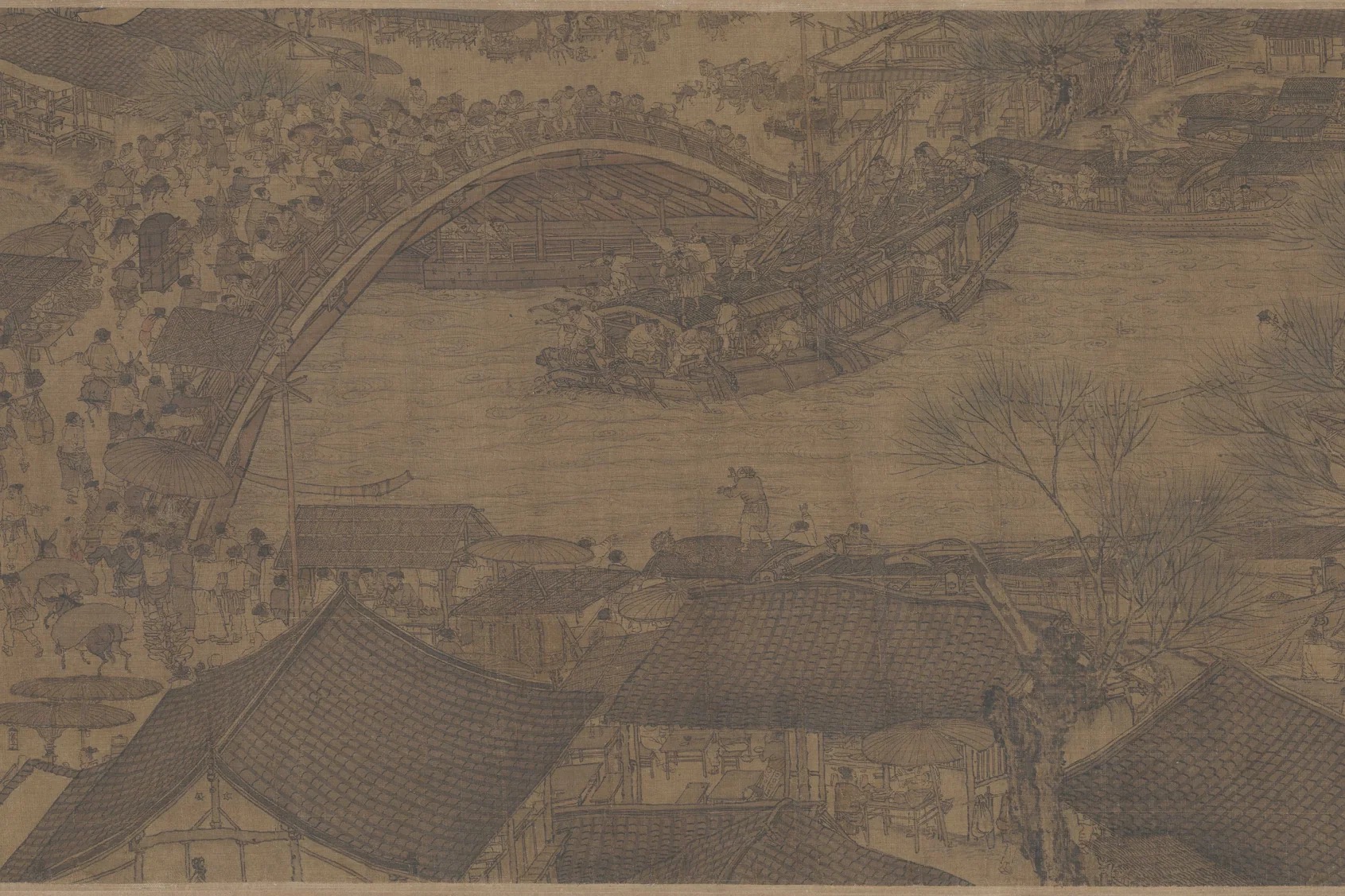
Zhang Zeduan’s Along the River During the Qingming Festival is one of the most famous Chinese paintings, and one of the easiest to look at badly. Seen as a small reproduction, it becomes a pleasant blur of rooftops and tiny people. Seen the way a handscroll is meant to be seen, it is closer to a long walk through a Northern Song city. The Palace Museum, Beijing, holds the scroll and describes it as a depiction of Bianjing, the Northern Song capital, now Kaifeng.
Start with what kind of object it is
The painting is a handscroll in light colours on silk. Commonly cited measurements are about 24.8 cm high and 528.7 cm long, so it is more than twenty times wider than it is tall. Nobody was meant to see all of it at once. A viewer unrolled a short section, looked, then rolled onward. If you have not yet met the format, how to view a Chinese handscroll explains the habit this painting depends on.
Follow the route, not the crowd
Writers divide the scroll differently. Some describe five sections, others three, but they agree on the broad route: quiet countryside at one end, a bridge over the river in the middle, and the denser streets near the city gate at the other. That order is the easiest way in. Begin in the open outskirts, where travellers on donkeys, trees and low roofs set a slow pace. The painting then gathers speed as the river and the buildings press closer together.
Notice how much of the early section is empty ground and bare branches. The painter spends the quiet passages generously, which makes the busy ones feel crowded by contrast.
The Rainbow Bridge: a scene with a problem in it
The centre of the route is the arched wooden bridge often called the Rainbow Bridge. Look first at the arch itself: a single sweep of timber with no pier in the river, drawn with a draughtsman’s patience. Then look at what is happening around it. The deck is lined with stalls and walkers. On the water, a large boat with a tall mast is passing under the arch, and people on the boat and at the railings seem to be calling out and pointing. Whether you read it as a near miss or a routine manoeuvre, the painter has staged a small piece of tension in the middle of an everyday scene.
This is a good test of how to read the whole scroll. Each patch holds several short stories that do not need to be resolved: a porter, a shopkeeper, a rider, someone leaning over a railing to see.
Details worth finding
- Roofs and timber. Tiled and thatched roofs, awnings and market umbrellas are drawn precisely enough to compare one building with the next.
- Trees as punctuation. Bare willows and pines mark pauses between busy passages.
- Animals and carts. Donkeys, oxen and covered carts carry goods and people along the roads.
- Brush discipline. The lines are fine and controlled throughout, which suits a painting about observed daily life.
What the title does not settle
The English title suggests a festival scene, but viewers and scholars have read the title and the date of the scene in different ways, and the picture does not label itself. It is safer to treat the scroll as a portrait of a busy city in motion than to assume a specific holiday. Also remember that many later versions exist. The Qing court version, for instance, is a different painting, so check which scroll a reproduction follows before you compare details.
Explore next: handscroll, hanging scroll or album leaf, and our checklist for buying a Chinese painting print. HUALI’s digital edition of this scroll is on its collection page.
Sources: The Palace Museum, Beijing, collection record; Wikipedia, “Along the River During the Qingming Festival” (dimensions and section divisions); Berkshire Encyclopedia of China entry (three-section reading).